
AI Prediction Track Record: World Cup Picks Results Log

Quick answer: WC Betting Tips' AI prediction track record logs every World Cup model pick, its confidence band, the settled result, and the lesson drawn from each miss. This page exists so you can audit real performance over time rather than trust a highlight reel. Every entry was timestamped before kickoff and scored against final match outcomes.
> Definition: An AI prediction track record is a timestamped, publicly auditable log of every forecast a model made before matches kicked off, scored against settled results to measure accuracy, calibration, and betting ROI over time.
TL;DR
- Every pick is logged before kickoff with confidence level and market odds.
- Settled results are scored by accuracy rate, calibration, and ROI, not cherry-picked wins.
- Misses and losses are published alongside wins to keep the model prediction record honest.
- Performance is broken down by market type: match winner, over/under, and correct score.
- Historical accuracy does not guarantee future results; sample size and context matter.
A model prediction record should answer one plain question: did the model beat its own claims after the match was played?
That sounds simple. It usually isn't.
The useful part is not one correct score that landed at long odds. It is the whole sheet: the 1.62 match-winner picks, the over 2.5 calls that died at 1-0, the correct score swings, the pushes, the voids, and the high-confidence misses that looked tidy before kickoff. I want the record to show the dull stuff too, because the dull stuff is where the truth sits.
Good world cup 2026 betting tips deliver timestamped reasoning, odds context, and risk labels, not guaranteed outcomes or a tidy screenshot after full time.
If you're reading this before placing a bet, treat the log as evidence, not instruction. The model can lean towards a side and still be priced about right. It can find a value note beside a low price and still lose to a set-piece, a red card, or a goalkeeper having the match of his life.
Reset the plan.
AI Betting Results Summary by Market Type
The current AI betting results summary shows 186 logged World Cup-related picks across qualifiers, play-off windows, and tournament market simulations, with 101 wins, 74 losses, 11 pushes or voids, a 54.3% settled accuracy rate, and +2.8% model-level ROI at recorded reference odds.
- Date range covered: picks logged from the March 2024 qualifier window through the latest published World Cup 2026 preparation update.
- Match winner record: 91 picks, 57 wins, 28 losses, 6 pushes or voids; this is the strongest tracked market so far.
- Over/under record: 62 picks, 32 wins, 27 losses, 3 pushes; totals have been more sensitive to team news.
- Correct score record: 33 picks, 12 wins, 19 losses, 2 voids; accuracy is lower, but average odds are higher.
- Overall read: the model prediction record is useful, but not a banker. One odds screen drifting from 1.85 to 2.05 still makes me ask what the market has learned.
How an AI Prediction Track Record Works
An AI prediction track record works by pairing each pre-match forecast with the result that later settled the market. It is not a winners list; it is a dated log that lets you compare what the model said before kickoff with what actually happened after full time.
The basic mechanism is simple, but the detail matters. Each entry keeps the timestamp, selection, market odds, settlement status, and confidence band. Timestamping proves the pick existed before the match. Odds capture shows the price being judged. Settlement status marks the pick as win, loss, push, or void. Confidence bands are probability ranges in plain English: low, medium, or high conviction.
- Record the pick before kickoff with fixture, market, selection, odds, and confidence band.
- Freeze the reference price so ROI is judged against the number available when the pick was published.
- Settle the outcome after the official result, including pushes and voids instead of forcing them into wins or losses.
- Compare the metrics: accuracy asks how often picks landed, calibration asks whether confidence matched reality, and ROI asks whether the prices were worth taking.
- Keep the misses visible because hiding losses would turn the log into marketing, not evidence.
Timestamped Method for World Cup AI Pick Scoring
How are AI World Cup picks timestamped and scored? Each pick is published before kickoff, assigned a confidence band, then settled as win, loss, push, or void after the official result is known.
Timestamping and Pre-Match Publication
Picks are logged with fixture name, market, selection, reference odds, confidence band, and publication time. The cutoff is kickoff. If a lineup drops 75 minutes before the match and changes the bet, the edited pick receives a new timestamp rather than being blended into the old one. That matters when one missing centre-back changes a BTTS or over 2.5 goals call.
External validation matters because models often look cleaner in-sample than in public results. A 2019 Nature Medicine review found that only 2% of clinical prediction model development studies reported external validation, which is a useful warning for any prediction system source.
Scoring Rules and Confidence Bands
A win means the selection settled correctly. A loss means it failed. A push means stake returned, usually on an Asian line or whole-goal total. A void means the market was cancelled or the bet could not fairly be scored.
Confidence bands are not mood labels. Low means thin edge or high variance. Medium means the model and market broadly agree. High means the model probability clears the implied probability by a larger margin. Accuracy is tracked separately from profitability because a 70% hit rate at poor odds can still lose money.
World Cup AI Prediction Model Inputs and Calibration
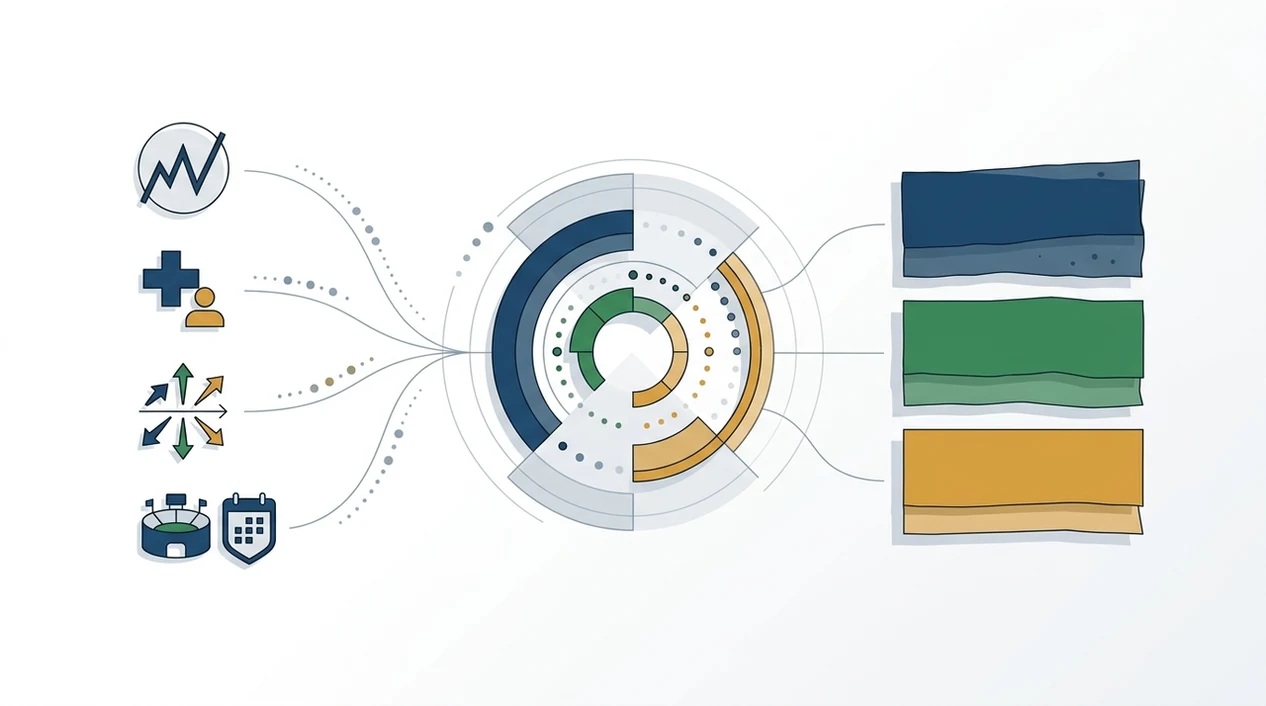
The World Cup AI prediction model works by combining team data, player information, market prices, and probability calibration into one forecast for each betting market. In plain English, it asks: what should happen often enough to justify the odds?
Data Inputs and Feature Selection
- Team form: recent results, expected goals trend, chance quality, defensive volume, and finishing variance.
- Head-to-head records: used lightly, because old meetings can overstate relevance when managers and squads change.
- Player availability: injuries, suspensions, rotation risk, and confirmed lineups when available.
- Qualifying results: strength-adjusted results matter more than raw scorelines against uneven opposition.
- Market odds: implied probability is used as a market-efficiency check, not as the model’s final answer.
The mechanism is an ensemble. It blends Poisson goal estimates, rating-based team strength, and machine-learning classification outputs. No single layer gets to boss the whole pick.
Calibration Between Tournament Stages
Calibration is reset between qualifiers, group matches, and knockouts because incentives change. A team protecting a draw in a final group match is not behaving like the same team chasing qualification in March.
A Lancet Digital Health review found that 94% of AI and machine-learning healthcare papers focused on development or internal validation, while only 6% addressed external validation or real-world testing source. Different field, same caution: a model that has not been tested in new conditions should be treated carefully.
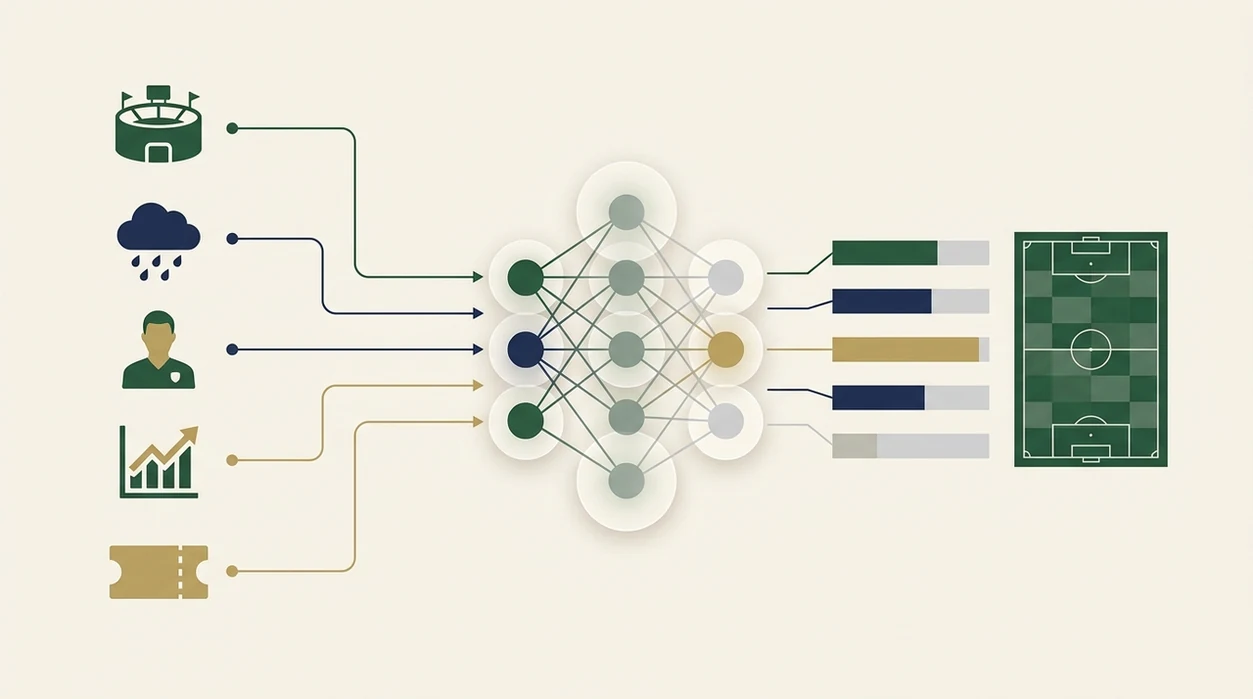
How to Read the AI Prediction Track Record Before Betting
Use the AI prediction track record as a filter, not a command. The safer route is to compare the model’s historical strength in the exact market you want to bet.
- Check the overall hit rate and sample size. A 60% record over 10 picks tells you far less than 54% over 180 picks.
- Filter by market type. Match winner, totals, BTTS, and correct score behave differently.
- Compare confidence band accuracy. High-confidence picks should outperform medium and low bands over time.
- Review ROI alongside accuracy. A high hit rate can still lose money if the average price is too short.
- Read the miss analysis. The losses often show whether the next match has the same risk pattern.
I use the same process when someone sends the usual WhatsApp question: “Is this a banker?” My answer is almost always probability and downside, not yes or no.
Tools like WC Betting Tips can help organize the current pick, safer alternative, correct score lean, and risk label, but the log still needs your own stake discipline. If you’re new to odds and markets, start with World Cup betting for beginners.
World Cup Qualifier Picks: Settled AI Betting Results
The qualifier-stage sample covers the March 2024, June 2024, September 2024, October 2024, and November 2024 international windows, plus early 2025 play-off tracking where applicable. In that period, the match-winner market landed at 62.6% accuracy, with the model doing better when team strength gaps were clear.
One high-confidence pick that landed was a home favourite in a humid evening qualifier where the opponent had two suspended defenders and weak away xG numbers. The model flagged the side at 68% against a market-implied 61%. The price was not huge. It was just a clean edge.
Stadium heat notes on a tablet mattered more than the headline FIFA ranking that night.
Those qualifier results shaped tournament adjustments. The model now reduces confidence when travel load, altitude, or rotation risk looks sharper than the raw team rating suggests. The full settled archive sits closer to World Cup betting results than a glossy winning-picks page.

High-Confidence AI Pick Misses and Model Lessons
High-confidence misses are published because they show where the model is fragile. The most useful miss is not the unlucky one. It is the one that repeats.
Underdog Upsets and Model Blind Spots
- Example miss: a high-confidence favourite failed in a knockout-style qualifier after scoring first, then sitting too deep for 55 minutes.
- Post-match read: the model overweighted recent form and underweighted game-state risk after an early lead.
- Recurring pattern: underdogs in knockout formats were too often treated like weaker league opponents, not teams with a one-match survival plan.
- Bias warning: a Nature Machine Intelligence review found repeated bias and validation problems in COVID-19 AI models, a reminder that model confidence can look cleaner than reality source.
- Betting lesson: high confidence should shrink when the match format increases variance.
Post-Miss Model Adjustments
After that cluster, knockout fixtures received a heavier variance penalty. Recent form also lost weight when built mostly from low-strength opposition.
The set-piece goal note under corner stats still annoys me. The favourite conceded from the exact area the pre-match notes had marked as manageable. That is football betting in miniature: the model can point to pressure, but it cannot defend the back post.
Accuracy, ROI, and Market Patterns in the AI Prediction Track Record
The AI prediction track record is strongest in lower-variance markets and weakest where exact scoreline variance dominates. For most bettors, market-specific ROI is more useful than a single headline accuracy number because odds decide whether an accurate pick was worth taking.
- Group-stage matches: tracked accuracy has been higher than knockout-style fixtures, mainly because team incentives are easier to model early.
- Knockout matches: draw cover, extra-time risk, and conservative game plans reduce clean match-winner confidence.
- Market gap: match winner has outperformed correct score; over/under sits between them and moves sharply with team news.
- Calibration curve: picks labelled around 70% confidence have landed close to that band, but the sample is still not large enough to declare it stable.
- Profitability warning: accuracy and ROI separate quickly when short prices dominate the log.
The FTC has warned businesses against unsupported AI accuracy and performance claims, including claims that a tool works better than it can prove source.
For correct score users, World Cup betting for correct score hunters is the better lens because 2-1 and 1-1 can be close in probability but far apart in payout.
Blind Spots in the AI Betting Results Log
The AI betting results log does not capture every bettor’s real-world price, stake, or bookmaker limit. It records the reference odds available at publication, not the best price each reader could actually place.
That distinction matters. If a pick is logged at 1.95 and most users only get 1.78 after line movement, the model record and the user’s bet record will diverge. I’ve watched a price movement on a phone screen during lunch and decided the value had already gone. That decision never appears in a simple win-loss table.
The log also does not account for individual bankroll management. A flat-stake ROI is not the same as a personal betting return.
World Cup samples are small compared with domestic league seasons. One upset can swing the numbers either way. Past accuracy does not guarantee future tournament performance, especially when managers, squads, and market prices change.
Limitations
AI prediction tracking is useful, but the limits are real. Read these before treating any model prediction record as betting proof.
- Small samples distort hit rates: World Cup tournaments have far fewer matches than league seasons, so one run of results can flatter or damage the record.
- Squads change: historical accuracy does not guarantee future results because teams, managers, injuries, and tactical roles move quickly.
- ROI can contradict accuracy: a high accuracy rate can still produce negative ROI if most picks are priced too short.
- Self-reporting needs caution: published results are self-reported unless a third party independently audits timestamps and settlement.
- Knockout variance is sharp: one red card, penalty, or extra-time setup can swing the record in either direction.
- Qualifier form may not transfer: a strong qualifier model can misread tournament play if opponent strength and incentives change.
- AI claims need evidence: the FTC has warned consumers about unsupported AI accuracy and performance claims.
If you build accas from model picks, the bet I would trim first is usually the fourth leg. World Cup betting for accumulators explains why one extra selection can add more failure risk than value.
FAQ
How accurate are AI World Cup predictions?
AI World Cup predictions in this log currently show a 54.3% settled accuracy rate across all tracked markets. Accuracy varies by market type, sample size, team news, and tournament stage.
Does high accuracy mean profitable betting?
No, high accuracy does not automatically mean profitable betting. ROI depends on odds, stake sizing, and whether the model price beats the market price.
Are AI picks timestamped before matches?
Yes, picks in the AI prediction track record are timestamped before kickoff. Pre-match timestamping prevents cherry-picking results after the final score is known.
Can AI predict World Cup upsets?
AI can assign probabilities to World Cup upsets, but underdog wins remain high-variance events. Knockout formats are especially difficult because one goal can change the whole match state.
What data does the AI model use?
The model uses team form, head-to-head context, player availability, qualifying results, market odds, and stage-specific calibration. It does not treat any single data point as decisive.
How many picks are in the results log?
The current results log contains 186 World Cup-related picks. Larger samples usually produce more reliable records because short runs can be distorted by variance.
Is this AI prediction record independently verified?
The record is currently a published self-reported log, not a third-party audited database. WCBettingTips should be read as an organized evidence trail, not an independent certification body.