
AI Football Prediction For World Cup Matches
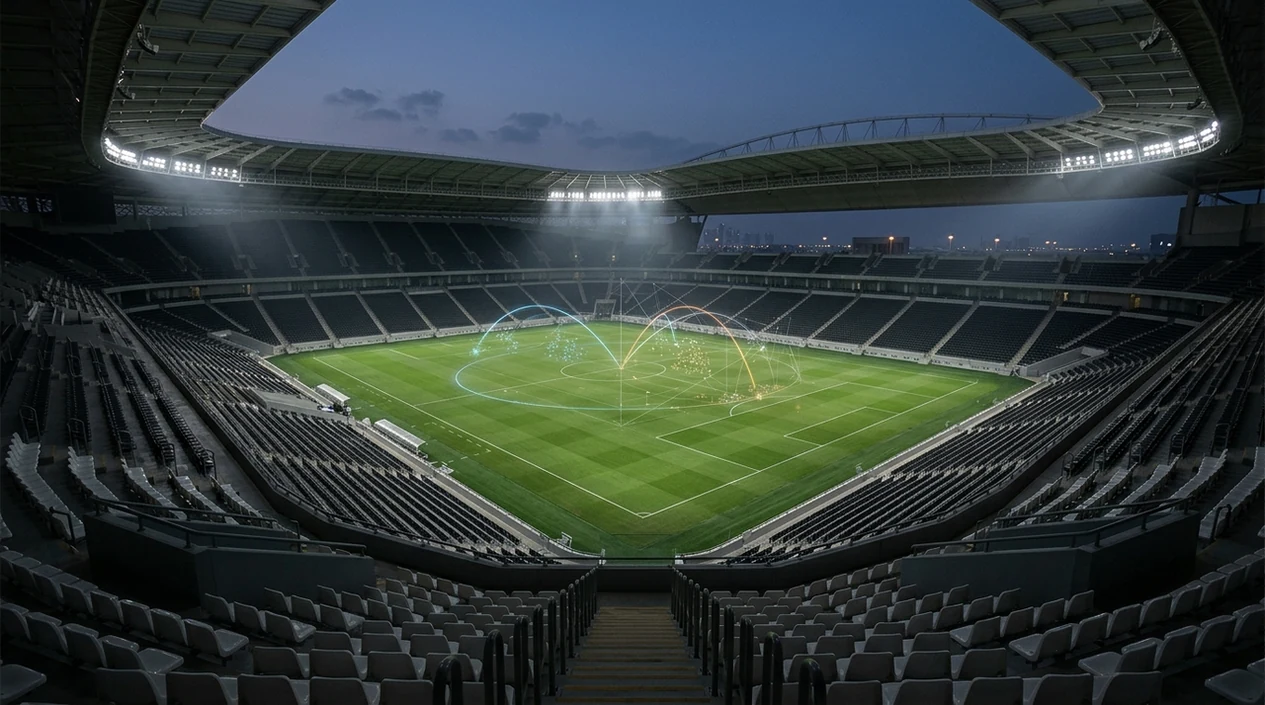
AI football prediction uses machine learning models trained on historical match data to estimate probabilities for World Cup outcomes such as match results, over/under goals, and both teams to score. These forecasts are probabilistic tools, not guarantees, and work best when combined with team news, odds context, and tournament-specific factors rather than treated as sure bets.
> AI football prediction is the application of machine learning or statistical models to estimate the probability of football match outcomes, including 1X2 results, goal totals, and correct scores, based on historical data, player performance, and contextual variables.
- AI models rank likely World Cup outcomes but cannot guarantee results in a low-scoring, high-variance sport.
- The most practical markets for AI football prediction are match result, over/under goals, and BTTS, not exact scorelines.
- Always cross-reference AI forecasts with bookmaker odds, injuries, and knockout-stage rules before placing any bet.
What AI Football Prediction Means for World Cup Bettors
AI match prediction means using data models to estimate what is more likely before a football match starts. For World Cup bettors, that usually means probabilities for 1X2, over/under goals, BTTS, and sometimes correct score.
The key word is probabilities. A model saying Argentina have a 58% win chance is not calling the match over. It is saying the price should be judged against that chance. I still check confirmed lineups around 75 minutes before kick-off, because one missing centre-back can move a BTTS view quickly.
World Cup forecasting is different from league football. Teams play fewer matches, managers hide tactical details, and neutral venues change the usual home advantage. Good world cup 2026 betting tips deliver probability, price context, and risk labels, not guaranteed winners.
Not a banker. A number.
Tools like WC Betting Tips, Forebet, and Football Whispers can help frame the market, but the final call still needs human judgement.
Five Facts About Football AI Forecasts for the World Cup
- Data quality decides the ceiling. A football AI forecast is only as useful as its inputs: recent form, xG, injuries, minutes played, travel, and lineup freshness. Old qualifying data can mislead quickly.
- The common markets are broad markets. AI models are most practical for 1X2, over/under 2.5 goals, BTTS, and double chance. Correct score belongs in the higher-risk column.
- Exact scores are fragile. A model may lean 1-1, but one early red card can turn that into a completely different match script. Correct score prediction is the bet I would trim first in most accas.
- Football has high single-match variance. Low-scoring matches leave less time for quality to show. That is why a strong side can dominate territory and still draw 0-0.
- Market comparison matters. AI outputs should be checked against odds, injuries, and tournament context. If a price drifts from 1.85 to 2.05, ask what the market has learned before calling it value. The broader accuracy question is covered in Are AI predictions accurate.
How AI Football Prediction Models Work
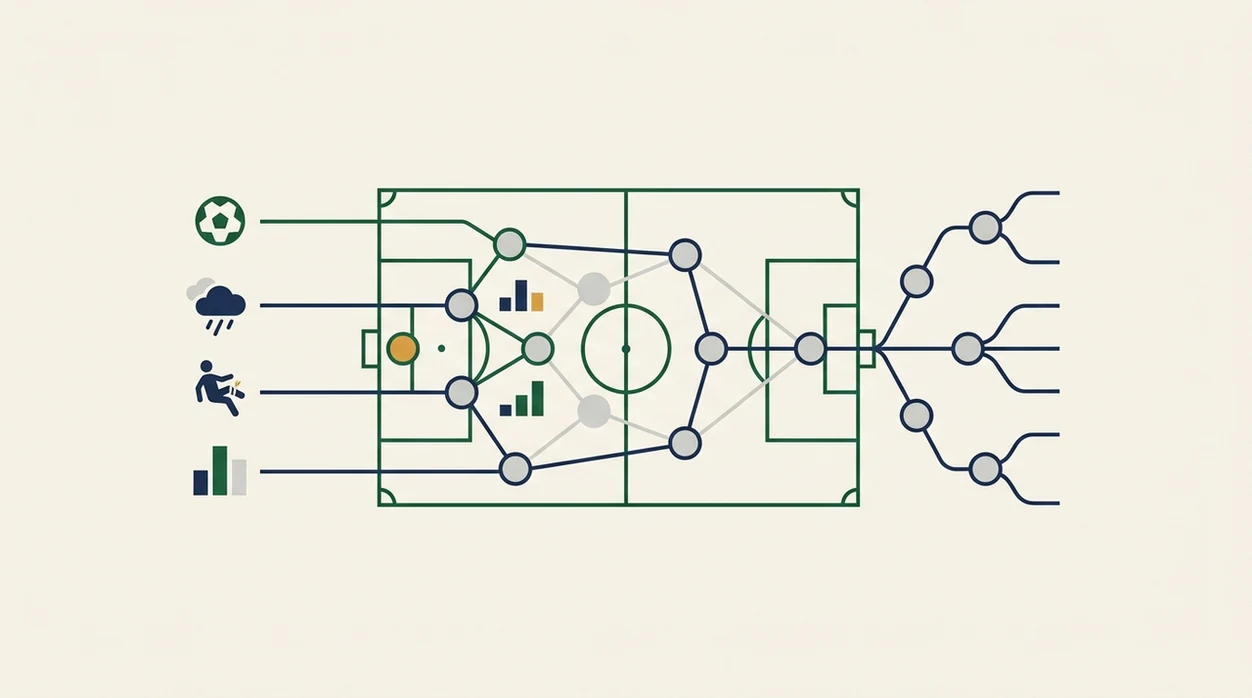
AI football prediction models work by training on past matches, then estimating a probability distribution across future outcomes. In plain English, the model does not give one answer; it assigns chances to several possible results.
The training data usually includes results, expected goals, shots, possession style, player metrics, and defensive numbers. Feature engineering adds context such as injuries, form, home or neutral venue, head-to-head record, tournament stage, and rest days. Some systems use Poisson distribution for goal counts; that is a way to estimate how often scorelines like 1-0, 1-1, or 2-1 may occur.
Calibration is the part bettors should care about. If a model marks a pick at 60%, it should win close to 60 times in 100 similar cases, not every Saturday. A 60% World Cup forecast still loses often.
That stings when it’s your slip.
Research on football forecasting has also shown that low-scoring variance limits match-by-match certainty; for example, academic work on football prediction consistently treats outcomes as probabilistic rather than deterministic: https://doi.org/10.1016/j.ijforecast.2018.06.001. For a deeper model breakdown, How AI predictions work explains the mechanics in more detail.
Before You Use AI Football Predictions
Before using AI football predictions, make sure the forecast matches the bet you are actually considering. Most bad reads come from mixing market rules, old team news, and staking decisions in the wrong order.
Run this quick check before treating any model pick as playable:
- Confirm the settlement period because a 90-minute result is not the same as “to qualify” in a knockout match. Extra time and penalties can make a strong team look safer than the 1X2 price really says.
- Match the market type before comparing probability with odds. A 55% lean on over 2.5 goals cannot be judged against BTTS, correct score, or team total prices.
- Wait for confirmed lineups when injuries, suspension risk, or likely rotation could change the model view. One rested striker or missing full-back can turn a decent number into a pass.
- Set your maximum stake first so the model’s strongest picks do not drag you into chasing. Write the limit down, then read the forecast.
That order keeps the bet grounded before the numbers start looking persuasive.
How to Use AI Match Predictions for World Cup Betting
Use AI match predictions as a filter, then decide whether the odds and team news still support the bet. For World Cup betting, the safer route is usually to compare model probability with market price before touching the stake box.
- Check the AI model’s predicted probabilities for 1X2, over/under goals, BTTS, and correct score.
- Compare the output with bookmaker odds by converting odds into implied probability.
- Review confirmed team news around 75 minutes before kick-off, especially centre-backs, goalkeepers, and main forwards.
- Adjust for knockout rules because extra time and penalties are not the same as a 90-minute result.
- Set your stake limit based on confidence, bankroll, and whether the market has already moved.
The deposit amount written before kickoff keeps the head calmer. It sounds basic, but it stops a model lean becoming an emotional chase after the first match goes wrong.
For accumulator work, compare the model’s strongest legs with AI betting tips and remove one leg too many when the price jump is not worth the added failure point.
World Cup Scoring Benchmarks That Shape AI Predictions
World Cup scoring benchmarks help AI models set realistic baselines for goals markets. In 2022, FIFA tournament data recorded 64 matches, 172 goals, and a 2.69 goals-per-match average. Source: FIFA’s Qatar 2022 tournament statistics report lists 172 goals across 64 matches: https://www.fifa.com/fifaplus/en/articles/qatar-2022-by-numbers-statistics-records.
Those figures matter because over/under and BTTS models need a starting point before adjusting for team strength, pace, injuries, and tactical setup. A model that treats every World Cup like a high-scoring domestic league will usually overrate overs.
The 2022 tournament also had 32 teams. World Cup 2026 expands the format, which changes sample dynamics and may add more mismatches, more rotation spots, and different group-stage incentives. That does not break the model, but it means historical scoring rates need context.
For BTTS, the model should look beyond the average. It needs both sides’ chance creation and concession profile. Our BTTS predictions page treats that market separately because BTTS is doing the heavy lifting in many World Cup slips.
Common Myths About AI Football Forecasts
Myth: AI can know the future. Reality: AI estimates probabilities from data. It cannot account cleanly for a deflection, a soft penalty, or a goalkeeper having one of those nights.
Myth: good winner picks mean good correct scores. Reality: correct score markets are far harder. A model can rate Spain as likely winners and still spread probability across 1-0, 2-0, 2-1, and 3-1.
Myth: more data always helps. Reality: noisy data can make a forecast worse. Club form from a different tactical role may not translate to international football.
Myth: AI is smarter when it disagrees with odds. Reality: bookmaker odds already contain team news, trader opinion, and market money. If the phone is balanced on a pub table and the odds suddenly shorten, I want to know why before betting against that move.
The useful comparison is not AI versus humans as a slogan. It is model output versus price, team news, and risk. The AI vs expert predictions debate only matters when both sides show their reasoning.
Common Mistakes When Using AI Football Prediction
The biggest mistake is treating an AI football prediction like a verdict instead of a price check. A 60% forecast is still a result that fails plenty of times, especially in a World Cup match with one goal, one red card, or one late substitution changing the whole read.
Use this short troubleshooting pass before you add the pick to a slip:
- Translate the probability properly so 60% means “better than the odds if priced right,” not “almost certain.”
- Compare the price at the right moment because a model edge can disappear after the market has already shortened. Do not judge yesterday’s forecast against today’s moved odds.
- Check the settlement rules in knockout matches, especially when the bet is for 90 minutes only and not extra time, penalties, or qualification.
- Trim correlated accumulator legs when they all need the same match script, such as one team dominating, over goals, and both attacking props landing together.
- Refresh the forecast near kick-off once confirmed lineups and late team news are out.
If two of those checks fail, I would rather leave the bet alone than pretend the model is still fresh.
Why Knockout Stages Change AI Match Prediction Accuracy
Knockout matches reduce AI match prediction confidence because the rules and incentives change. Extra time and penalties are not standard 90-minute outcomes, yet many betting markets settle on 90 minutes only.
Most models learn heavily from league data, where draws stand and teams do not manage the last 20 minutes with penalties in mind. That creates a gap. A side may accept 0-0 after 75 minutes in a quarter-final in a way it would not during a league run.
Sample size is another problem. There are not many comparable knockout matches for each national team, and tactical conservatism can pull scoring expectations down. The extra-time warning near a knockout fixture is not small print. It can change the bet entirely.
For knockout games, broad markets usually make more sense than exact scores because uncertainty spreads across more match states.
Limitations
AI football prediction has useful betting value, but it has clear limits. Treat it as one input, not the whole staking plan.
- Tournament sample sizes are small, so World Cup teams do not generate enough fresh matches for high certainty.
- Exact score and scorer predictions are far less stable than match result, double chance, or over/under markets.
- Late injuries, tactical switches, and rotation can distort a pre-match forecast within minutes.
- Historical models can underperform when conditions change, including expanded formats, weather, altitude, travel, or new rules.
- AI outputs are not guaranteed edges because bookmaker odds often price in similar information.
- A 60% probability still implies frequent losses across individual matches.
- Model calibration varies widely. Some tools publish probabilities without proving how those numbers performed.
- A correct-looking forecast can still be a bad bet if the price is too short.
I’d rather pass than force it. That is not cautious branding; it is how you keep the bankroll alive through a full tournament.
WCBettingTips uses risk labels and odds context for that reason, rather than treating every model lean as a play.
FAQ
How accurate is AI football prediction?
AI football prediction accuracy varies by model, market, and test sample. Broad match-result models are usually easier to validate than correct-score forecasts, but no serious model should present single-match World Cup picks as certain.
Can AI predict exact World Cup scores?
AI can estimate likely scorelines, but exact World Cup scores are hard to predict reliably. Correct score markets carry higher variance than 1X2, totals, or BTTS.
Is AI better than bookmaker odds?
AI is not automatically better than bookmaker odds. Odds already include market information, trader opinion, injuries, and betting movement.
Does AI work for knockout matches?
AI can be used for knockout matches, but confidence usually drops. Extra time and penalties create scenarios many models handle poorly.
What data do AI models use?
AI models usually use historical results, xG, player stats, injuries, form, head-to-head records, and venue conditions. Better models update close to kick-off.
Are free AI prediction tools reliable?
Free AI prediction tools vary widely in quality. Some lack fresh data, transparent calibration, or proper odds comparison.
Can AI predict both teams to score?
Yes, BTTS is a common AI football prediction output. It is usually more stable than correct score, but it still depends on lineups and match style.
Why do AI predictions fail often?
AI predictions fail because football is low-scoring and random at single-match level. Small tournament samples also limit certainty.
Should I bet only using AI forecasts?
No, AI forecasts should not be your only betting input. Combine them with team news, odds comparison, staking limits, and responsible bankroll management.