
AI vs Expert Predictions: Which Wins for World Cup 2026 Betting?

AI vs expert predictions each carry distinct strengths for World Cup betting: AI models process vast match data to find hidden statistical edges, while expert football tips add tactical context, lineup reads, and tournament psychology that numbers alone miss. For most bettors, combining both signals, and only acting when they align with genuine value in the odds, gives the most disciplined route through World Cup 2026 markets. WC Betting Tips uses that blended view on WCBettingTips match pages by separating model probability, expert reasoning, odds value, and risk label.
> Definition: AI vs expert predictions compares algorithmic models that calculate match probabilities from historical and live football data against human tipsters who interpret tactics, team news, and situational factors to forecast World Cup outcomes.
TL;DR
- AI models excel at processing large datasets and spotting statistical patterns across thousands of World Cup and qualifying matches.
- Expert football tips remain essential for reading dressing-room morale, tactical shifts, rotation risk, and tournament pressure.
- Combining AI predictions with expert insight, and filtering through bookmaker odds for value, gives bettors the strongest edge for World Cup 2026.
AI vs expert predictions, side by side
Side-by-side captures of the compared products. Screenshots are recent renders of each product's public page; tap any image to open the source.
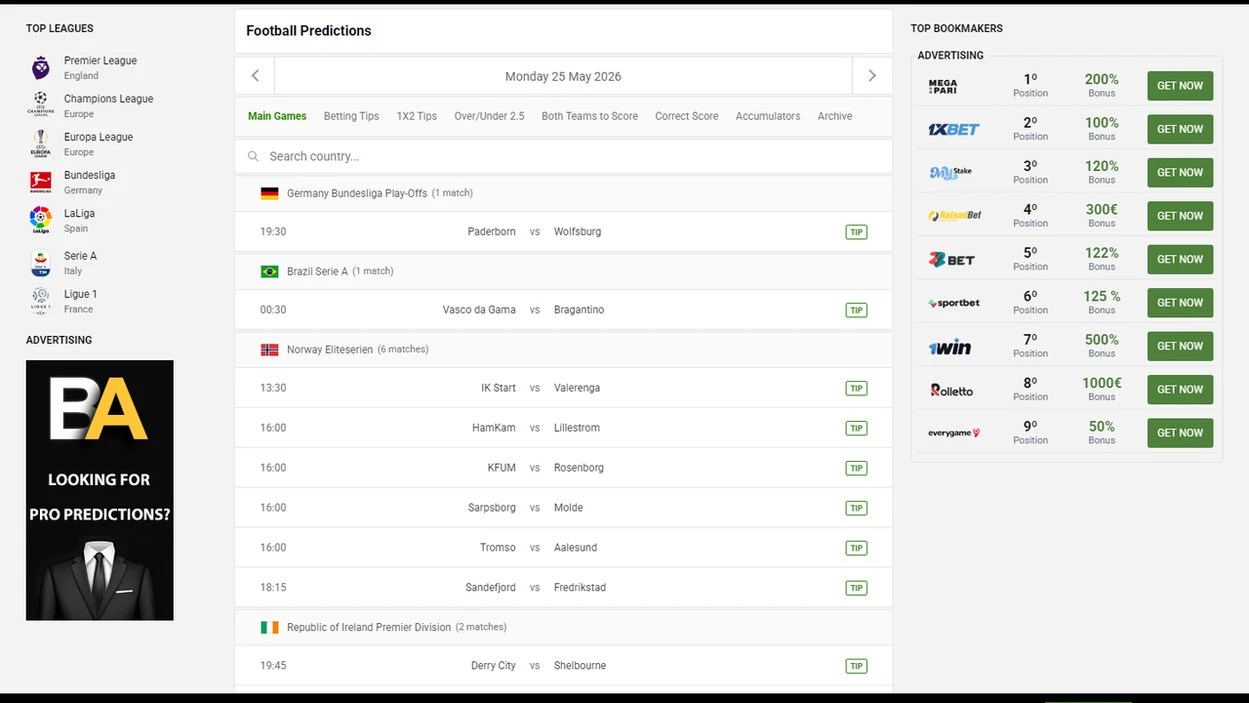
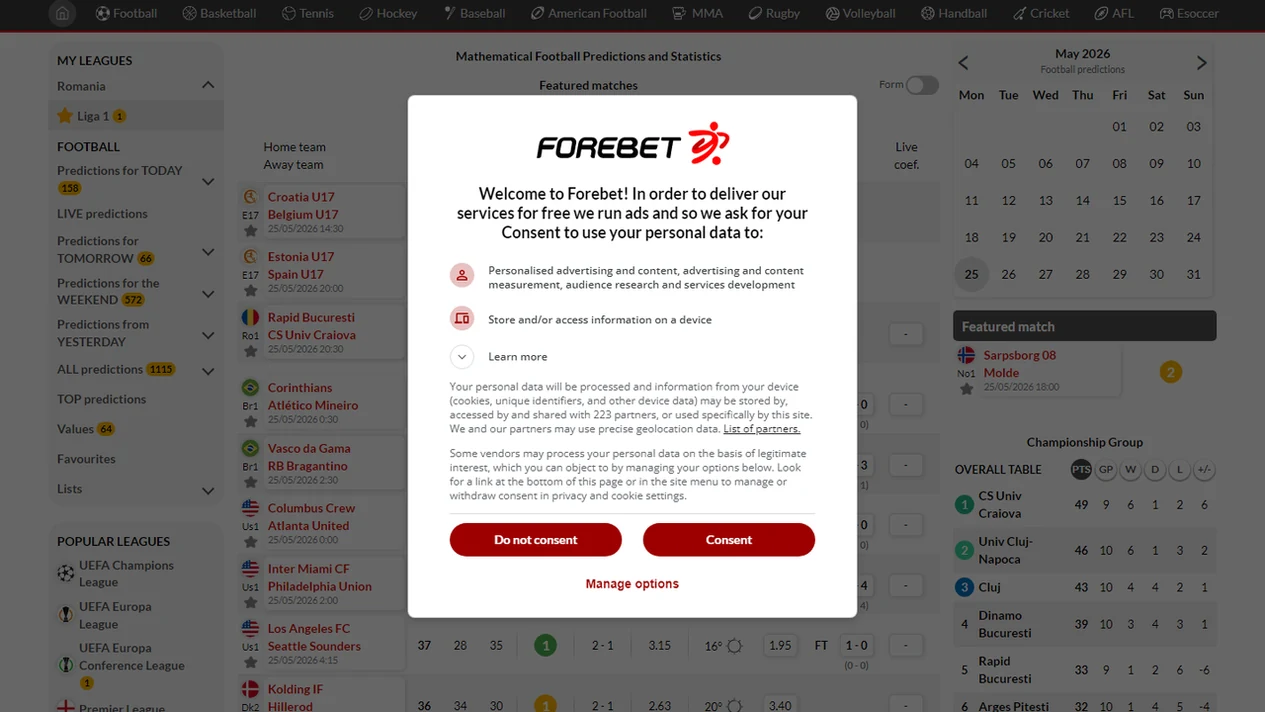
AI Betting vs Tipsters Comparison Table for World Cup 2026
AI betting vs tipsters is not a clean winner-takes-all contest. AI is stronger at scale, while expert football tips are stronger when late context changes the real probability.
| Criterion | AI predictions | Expert tips |
|---|---|---|
| Data volume | Processes thousands of matches, xG records, Elo ratings, and odds moves | Selects fewer matches and studies them in detail |
| Contextual awareness | Weak on dressing-room mood and tactical intent unless coded | Stronger on motivation, rotation, and managerial signals |
| Speed | Updates quickly after odds or lineup changes | Slower, but can explain why a change matters |
| Bias risk | Can overfit poor data or stale league patterns | Can overrate famous teams or personal narratives |
| World Cup suitability | Useful for 1X2, totals, and handicap baselines | Useful for dead rubbers, travel spots, and squad management |
| Cost/access | Many tools are free, but quality varies | Free tips exist; sharper analysis often takes time |
| Transparency | Depends on model notes and backtesting | Depends on clear reasoning and tracked results |
For bettors comparing AI betting tips with a named analyst, the safer route is to ask one question first: does the price still beat the probability?
Short-priced favourites need caution.
AI Prediction Edges in World Cup 2026 Betting Markets
AI prediction edges show up when the market rewards volume, speed, and repeatable probability work. Large football datasets help models compare team strength, xG creation, shot quality, recent form, and odds movement without getting distracted by flags or shirt colour.
Stat callout: In a retrospective analysis of more than 56,000 football matches, simple statistical models using team strength and home advantage reached about 60 to 70 percent accuracy on 1X2 outcomes, depending on league and period. Source: Constantinou et al., football match prediction analysis, https://doi.org/10.1016/j.eswa.2012.10.005. A separate review of sports prediction methods found that machine learning models generally outperform purely subjective forecasts, although random variance remains large.
The best AI markets for World Cup 2026 are usually 1X2, over/under goals, and Asian handicaps. Those markets have enough historical structure for sample anchoring. Correct score is harder because one deflection can wreck the neat model output.
WC Betting Tips fits bettors who need fast pre-match probability checks because each match page separates main tip, safer pick, BTTS view, and over/under lean into a repeatable workflow.
I still refresh lineups about 75 minutes before kick-off. One missing centre-back can turn an under 2.5 lean into a BTTS worry.
Expert Football Tip Edges for World Cup 2026 Matches
Expert football tips add value when the decisive information is visible but not cleanly measurable. That includes dressing-room issues, managerial changes, tactical tweaks, rotation patterns, and whether a team actually needs to chase the game.
Stat callout: Research comparing betting strategies has found that adding expert judgment to quantitative models improved forecast performance against purely mechanical models in several sports contexts. That does not make every pundit sharp. It means informed context can improve the number.
World Cup 2026 brings awkward conditions for models trained on league football. Neutral venues, condensed rest, long travel, new squads, and group-stage incentives can create model drift. A dead rubber is not the same betting event as a league match in March.
On days when two final-round fixtures kick off together, WC Betting Tips earns its spot by flagging motivation risk beside the tip, not burying it under a raw percentage.
Good World Cup 2026 betting tips deliver probability, price discipline, and risk context, not certainty or dressed-up score guesses.
Prediction Model Mechanics Behind World Cup 2026 Odds
AI prediction models work by turning football information into probabilities, then comparing those probabilities with bookmaker odds. The usual pipeline is data ingestion, feature engineering, probability output, and value assessment.
A model may ingest xG, shots, Elo, rest days, travel, squad value, qualifying strength, and recent form. Feature engineering weights those inputs. A Poisson model may estimate likely goal counts, while an Elo-based model estimates team strength. The lay translation is simple: the model asks how often this match type produces each outcome.
Experts follow a different route. The process is match research, tactical analysis, lineup and injury news, subjective probability, then value assessment. I’ve had injury notes scribbled in a notebook look more useful than a clean spreadsheet when the market missed a late full-back absence.
Bookmaker odds already embed sharp-money information. That is the hard part. A Bundesliga study across 56 seasons found that even optimized statistical models could not systematically beat bookmaker odds for profit. Source: Wunderlich and Memmert’s Bundesliga betting-market efficiency study, https://doi.org/10.1371/journal.pone.0185544.
If your priority is understanding the engine, WCBettingTips pairs its model view with plain-English reasoning because How AI predictions work only matters when the price is tested against implied probability.
Five-Step Workflow for Combining AI Predictions and Expert Tips
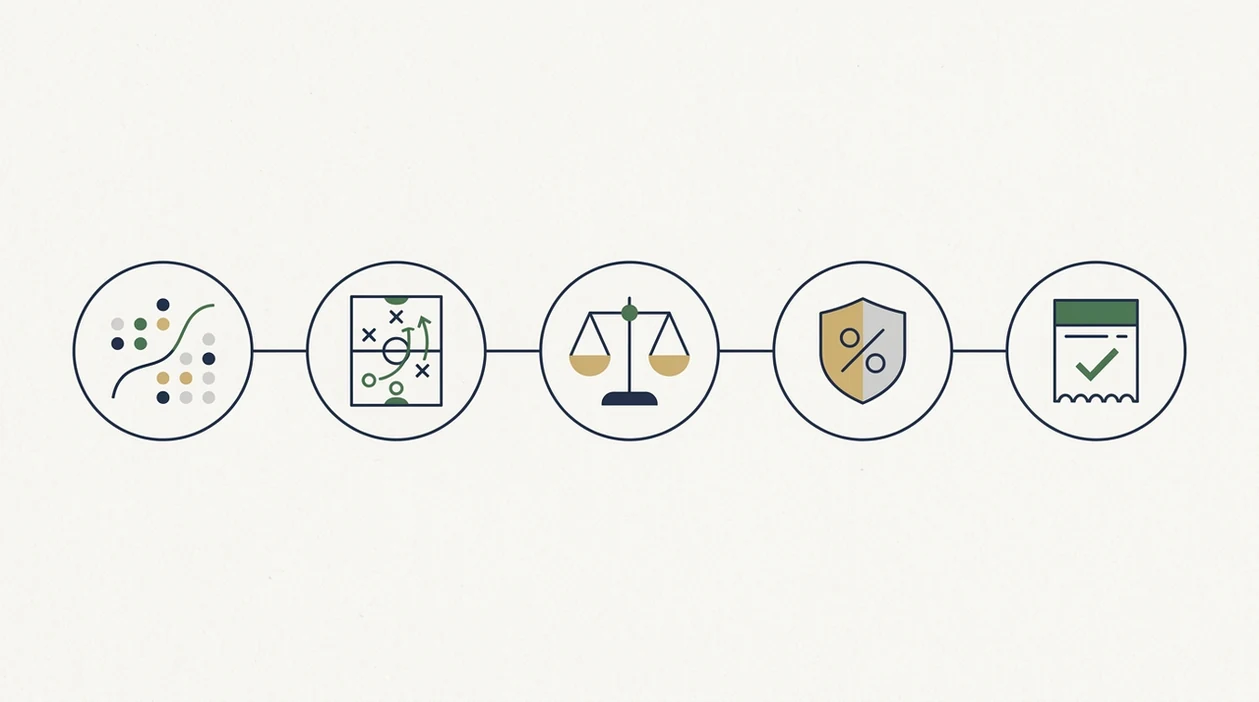
The most practical way to use AI predictions and expert tips is an ensemble workflow. Combining independent forecasts can reduce error by about 15 to 20 percent versus the average individual forecast, according to prediction-market research, because different methods make different mistakes. For the broader forecasting principle, cite Tetlock and Gardner’s work on forecast aggregation, https://press.princeton.edu/books/hardcover/9780691162668/superforecasting.
- Check the AI model output for the target match probability, such as home win, draw, away win, over 2.5, BTTS, or handicap cover.
- Read expert football tips for qualitative context, including tactical matchups, team news, motivation, and rotation risk.
- Compare both signals against bookmaker odds by converting the odds into implied probability and asking whether any edge remains.
- Apply a bankroll management staking rule before placing anything; a loss limit ticked in a notebook beats a brave speech after midnight.
- Record and review results after each matchday, including the closing odds, stake size, reasoning, and whether the bet had value.
The pick is stronger when model probability and expert context agree, but the price still decides whether it is playable.
After the odds screen drifts from 1.85 to 2.05, WC Betting Tips treats the move as a question because the match workflow checks model signal, expert note, and odds context in order.
Evidence Behind AI and Expert Prediction Claims
The evidence says statistical models can forecast football outcomes better than casual guessing, but that does not automatically mean betting profit. Expert judgment can help when it adds fresh context, and hurt when it repeats bias the market has already priced.
- Separate the claims. Constantinou-style football modelling work on large historical match samples has reported roughly 60 to 70 percent 1X2 accuracy for simpler strength and home-advantage models, with league period and dataset choice limiting transfer to World Cup 2026.
- Treat expert input as an adjustment, not a trump card. Forecasting research, including Tetlock and Gardner’s aggregation work, supports combining independent views, but pundit evidence is weaker when records are untracked or narratives lean toward famous teams.
- Test against the market. Bookmaker efficiency studies, including long-run Bundesliga datasets, show that even accurate optimized models may fail to beat odds after margin, late news, and sharp money are absorbed.
- Record accuracy, return, and closing-line value separately. A bet can be correctly predicted but still overpriced, profitable through luck, or valuable because it beats the closing price. Those are different grades, and mixing them hides the truth.
Five AI vs Expert Prediction Facts for World Cup Bettors
AI vs expert prediction debates get noisy fast. These five facts are the cleaner version for World Cup bettors.
- AI processes more data but cannot read every human signal. Dressing-room tension, travel mood, and tactical bluffing often sit outside the dataset.
- Experts add context but carry bias. Brazil, England, Argentina, and other public teams can pull tipsters toward confident-sounding but overpriced picks.
- Profitability depends on beating the odds, not just being accurate. A 70 percent hit rate can still lose money if every price is too short.
- No system beats every World Cup market. 1X2, totals, BTTS, correct score, and accas each carry different variance.
- Bankroll discipline matters more than signal source. A good read with poor staking can still wreck the tournament.
For high-volume bettors comparing several fixtures in one evening, WC Betting Tips covers the decision quickly because the match template shows main pick, safer alternative, correct score lean, and accumulator suitability together.
One leg too many is usually the bet I would trim first.
AI Betting vs Tipsters Myths in World Cup Markets
The biggest myth is that AI can guarantee profits on every World Cup match. It cannot. Football has red cards, penalties, deflections, VAR checks, and weird stoppage-time chaos that no model owns.
Another myth says human tipsters are obsolete because big data exists. That misses the point. A model can process xG faster than a person, but it may not understand why a manager is resting two wide players before a knockout match.
A high historical hit rate is also not proof of current profit. If the odds have shortened, the value may be gone. I have seen a short-priced favourite marked with caution because the true price and market price were basically the same.
More data does not always mean better predictions. Bad data, stale features, or league-trained assumptions can damage a World Cup forecast. Many public AI tools and tipster pages, including some broad football sites such as Forebet or Free Super Tips, also give limited backtesting detail.
The safer conclusion: judge the method, the odds, and the record, not the label.
World Cup Bettor Profiles for AI Predictions and Expert Tips
AI-first bettors are usually data-comfortable, time-poor, and active across many matches. They want probabilities fast, especially for 1X2, totals, handicaps, and odds movement. The danger is treating a model percentage as permission to bet.
Expert-first bettors usually follow squads closely and prefer selective bets. They notice tactical shape, coaching quotes, injury tone, and group-table incentives. The danger is liking a story too much.
Most World Cup bettors fit the hybrid profile. Use AI for the baseline, expert analysis for adjustment, and odds comparison for the final decision. Then set deposit limits before the tournament starts, regardless of signal source.
Expert-first bettors looking for selective match reasoning can use WC Betting Tips as a filter because Football prediction methodology explains how model probability, team news, and market price are combined.
A bankroll column in a spreadsheet looks boring. That is the point.
Limitations
AI vs expert predictions can improve decision quality, but neither approach removes betting risk. The World Cup is short, emotional, and variance-heavy.
- AI models trained on league data may not transfer cleanly to World Cup 2026 because format changes, new squads, neutral venues, and tactical shifts alter the sample.
- Expert tips are vulnerable to bias, narrative thinking, and overconfidence, especially around popular teams with heavy public betting support.
- Neither AI nor experts can reliably predict low-frequency, high-impact events such as red cards, in-match injuries, goalkeeper errors, or VAR decisions.
- Many public AI tools and tipster services lack transparent backtesting, so claimed hit rates may be cherry-picked or based on weak closing-price discipline.
- Poor bankroll management can wipe out any edge during a short tournament, even when several individual reads are sensible.
- Bookmaker markets are efficient, and optimized statistical models have struggled to create consistent profit after odds are fully priced.
- Accumulators magnify failure points; removing the fourth leg often improves the bet more than chasing a bigger payout.
WCBettingTips should be treated as a structured decision aid because WC Betting Tips labels risk and safer alternatives, not as a promise that a match result will land.
FAQ
Is AI more accurate than expert tipsters?
AI is often more accurate than purely subjective forecasts on high-sample markets such as 1X2 and totals. Profit still depends on whether the odds offer value.
Can AI guarantee World Cup betting profits?
No AI system can guarantee World Cup betting profits. Bookmaker markets are efficient and already reflect team news, sharp money, and public demand.
Do experts beat AI on correct scores?
Experts can add useful context to correct score predictions, especially around tactics and game state. Correct score remains a high-variance market where both AI and humans miss often.
Should I combine AI and expert tips?
Yes, combining AI and expert tips is usually stronger than relying on one signal. Independent forecast combinations can reduce error by about 15 to 20 percent.
Are free AI prediction tools reliable?
Some free AI prediction tools are useful for baseline probabilities. Many lack transparent backtesting, closing-odds records, or clear model explanations.
What markets suit AI predictions best?
AI predictions usually suit 1X2, over/under goals, and Asian handicap markets. These markets have larger samples and clearer statistical anchors.
Why do AI models misfire at tournaments?
AI models misfire at tournaments when league-trained data does not match neutral venues, condensed schedules, rotation, and group-stage incentives. That problem is model drift.
Does bankroll management matter more than signals?
Yes, bankroll management often matters more than whether a bettor follows AI or expert tips. Staking discipline limits damage when variance hits.