
Football Prediction Methodology: How We Build Our World Cup Picks Model

Quick answer: Football prediction methodology combines ELO-based team ratings, Poisson match-outcome probabilities, injury data, venue factors, and bookmaker odds into a repeatable scoring framework for World Cup picks. Each prediction is logged, tracked against closing lines, and reviewed after every matchday so the model can be audited and improved.
> Definition: A football prediction methodology is a documented, repeatable process for converting match data, including team strength ratings, player availability, contextual variables, and market odds, into calibrated probability estimates for match outcomes.
TL;DR
- We use ELO ratings, Poisson regression, and bookmaker-implied probabilities as the three pillars of every World Cup prediction.
- Contextual variables like host status, travel distance, rest days, and climate are factored into every match forecast.
- Every pick is logged with pre-match odds and reviewed post-match so we can publish transparent accuracy records and admit where the model fails.
What Football Prediction Methodology Means for World Cup Betting
A football prediction methodology is a documented, repeatable process for converting match data, including team strength ratings, player availability, contextual variables, and market odds, into calibrated probability estimates for match outcomes.
For World Cup betting, that matters because a tip without a method is just an opinion with a price beside it. A clear method shows what data went in, how the probability was built, and where the uncertainty sits. It also lets you ask better questions when a pick loses.
The pick is never the whole story.
Good world cup 2026 betting tips deliver probability, price context, and risk labels, not guaranteed outcomes or 90th-minute comfort. Even strong models leave plenty to variance. A red card, deflection, or missing centre-back can wreck a clean pre-match view. That is why the method has to be visible before the bet feels persuasive.
Data Sources and Requirements for a World Cup Betting Prediction Model
A World Cup betting prediction model needs team strength data, match history, squad news, market prices, and contextual variables before it can produce useful probabilities. Missing one layer usually makes the model too brittle.
- ELO and FIFA rankings measure different things: ELO reacts more directly to match results and opponent quality, while FIFA rankings give an official baseline across all national teams.
- Historical match data sets the base rate: We use World Cup matches from 1950 to 2022 to study scoring patterns, favourite performance, draws, and knockout-stage behaviour. For the match-history layer, cite a reproducible results source such as the openfootball World Cup dataset (https://github.com/openfootball/worldcup) and cross-check tournament records against FIFA's official archive (https://www.fifa.com/en/tournaments/mens/worldcup).
- Squad data changes the match forecast: injuries, suspensions, late call-ups, and starting XI leaks can move BTTS, over 2.5, and correct score probabilities.
- Opening and closing odds are independent signals: if a screen drifts from 1.85 to 2.05, the model asks what the market may have learned.
- Macroeconomic and climate variables add context: GDP, population depth, temperature, altitude, and regional conditions help explain why national team performance is not only tactical.
Team Strength Ratings: ELO and FIFA Rankings
ELO is the sharper match-input layer. FIFA rankings are still useful, but I treat them as a reference point, not the engine.
Market Odds as an Independent Data Layer
Bookmaker prices are not ignored. They aggregate public information, sharp money, team news, and sometimes plain overreaction.
World Cup Model Process: Poisson, ELO, and Contextual Weighting

The World Cup model process works by estimating each team’s expected goals, converting those goal rates into win/draw/loss probabilities, then adjusting for opponent quality, venue, rest, travel, and odds value. In plain English: it asks how often this match should land each way, not who “should” win.
Poisson Regression for Match Outcome Probabilities
Poisson regression estimates likely goal counts from attack and defence parameters. Those expected goals create a scoreline grid, such as 1-0, 1-1, 2-1, and 0-2. From that grid, we sum home win, draw, away win, BTTS, and over/under probabilities. Correct score work sits here too; the three-one alternative beside xG notes is often where the risk becomes obvious.
Contextual Adjustments: Venue, Climate, and Rest Days
ELO adjusts for recent form and opponent quality. Contextual weighting then adds host status, travel distance, rest days, altitude, and climate match. Published forecasting work supports combining team-strength ratings, market information, and tournament context rather than relying on rankings alone; see Groll et al. on World Cup forecasting (https://doi.org/10.1016/j.ijforecast.2019.10.001) and Hvattum and Arntzen on ELO ratings in football prediction (https://doi.org/10.1016/j.ijforecast.2010.10.002).
For World Cup bettors, Poisson probabilities are often easier to audit than black-box models because every scoreline must add up to a visible match probability.
Before You Start: Inputs Needed for Football Prediction Methodology
Before you run a football prediction methodology, you need clean match data, prices, squad information, and a written staking setup. If those inputs are not timestamped, the forecast cannot be checked later and should not guide a bet.
- Gather the minimum match file: record the fixture, venue, kick-off time, team ratings, recent results, expected goals inputs, injuries, suspensions, travel, rest days, and weather or altitude notes.
- Define the odds snapshots: save the opening price, the current available price when you analyse the match, and the closing price after the market settles before kick-off.
- Confirm squad news before staking: wait for confirmed lineups where possible, or at least reliable probable team news, before turning a model edge into a final stake.
- Set the betting assumptions: write down bankroll size, maximum stake, available bookmakers or exchanges, market access, and whether odds are decimal, fractional, or American.
- Keep timestamped records: log every input change, especially odds moves and team news updates, so the next review can separate good process from lucky timing.
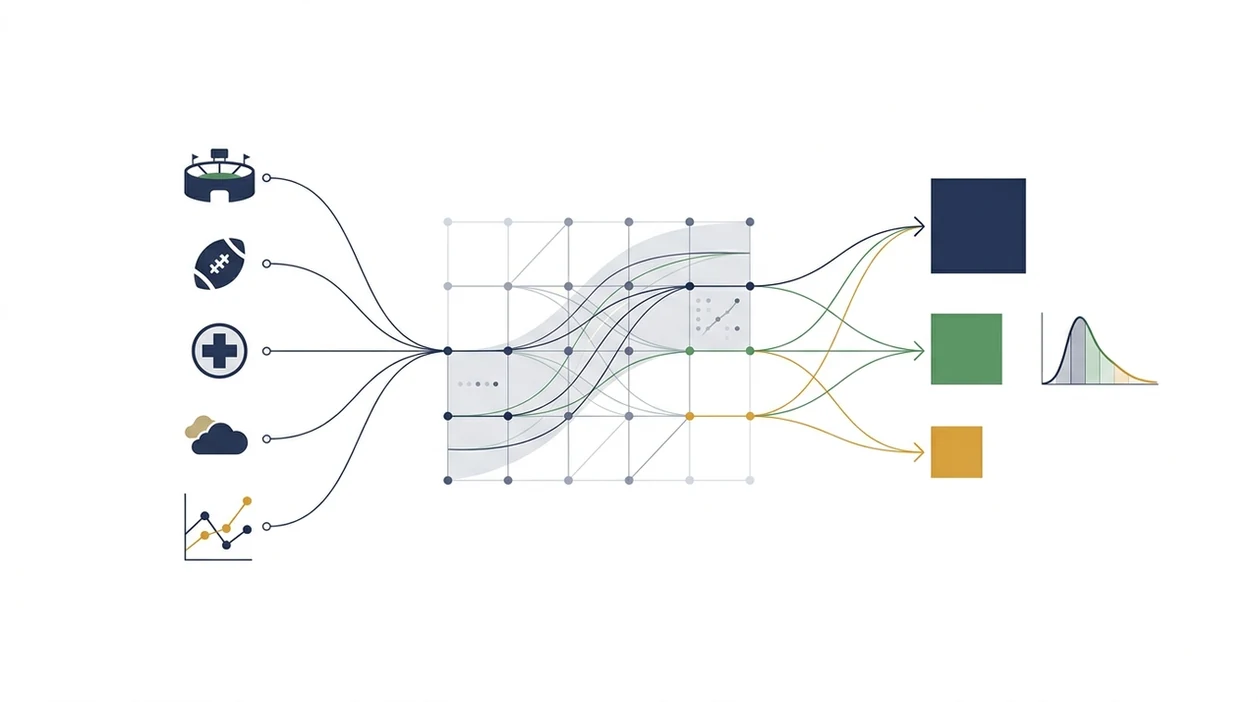
6-Step Workflow for Applying This Football Prediction Methodology
Use this workflow when applying the methodology to a World Cup match. It keeps the model honest and stops one late opinion from overriding the numbers.
- Collect pre-match data: pull ELO ratings, FIFA rankings, squad news, injuries, suspensions, opening odds, and current odds.
- Run the Poisson model: generate expected goals, scoreline probabilities, and home/draw/away percentages.
- Apply contextual adjustments: account for host status, travel, rest days, altitude, temperature, and climate fit.
- Compare against bookmaker odds: convert odds into implied probability and look for a gap after margin is considered.
- Log every pick: record the stake, odds, market, predicted probability, and reason before kick-off.
- Review after matchday: update inputs, check model error, and separate bad process from normal variance.
Reset the plan.
If confirmed lineups land 75 minutes before kick-off and a starting centre-back is missing, the BTTS and over 2.5 numbers may need a fresh pass. The broader model logic is similar to the probability workflow explained in How AI predictions work, but the final call still needs football judgement.
Validation and Back-Testing for the World Cup Prediction Model
Validation proves whether the model adds anything beyond obvious favourites and bookmaker prices. We back-test on the 2010, 2014, 2018, and 2022 World Cups, then check qualifying campaigns for a wider sample.
| Benchmark test | What it checks | Why it matters |
|---|---|---|
| Back-test 2010–2022 World Cups | Match picks, totals, BTTS, draw rate | Tests tournament conditions, not league habits |
| Qualifier cross-validation | Out-of-sample national-team results | Adds volume beyond limited World Cup matches |
| Raw ELO baseline | Team-strength-only forecast | Shows whether extra variables help |
| Always back favourite | Simple market-following approach | Exposes weak models dressed as analysis |
| Closing line comparison | Model price vs final market price | Tests whether the pick beat available information |
Calibration Checks Against Actual Outcomes
Calibration asks whether 60% predictions happen about 60% of the time. If they land 48%, the model is overconfident.
Benchmarking Against Bookmaker Closing Lines
Optimized football models usually earn only a modest edge over bookmaker odds. That is why we publish accuracy records openly. A cold drink beside match notes feels better after a win, but the spreadsheet matters more the next morning.

Host Nation Advantage and Venue Factors for the 2026 World Cup Model
Host nation advantage matters, but the 2026 World Cup makes it harder to model than a single-country tournament. Since 1950, four men's World Cup hosts have won the tournament, England 1966, West Germany 1974, Argentina 1978, and France 1998, so host advantage belongs in the model without being treated as decisive; verify host and champion records against FIFA's tournament archive: https://www.fifa.com/en/tournaments/mens/worldcup.
The 2026 format has three hosts: USA, Canada, and Mexico. That complicates the old “home advantage” input because a match in Mexico City is not the same environment as a match in Vancouver or New Jersey. Travel distance, altitude differential, and climate matching all need separate weights.
A team used to temperate European conditions may not respond the same way to heat, humidity, or altitude. The model re-estimates host effect for the expanded 48-team, 104-match format rather than copying a 32-team assumption. If the lineups land as expected, venue still nudges the probability; it does not decide the bet on its own.
Common Mistakes in Football Prediction Methodology
The biggest mistake in football prediction methodology is treating a model output as certainty. A 58% edge still loses often enough to make your WhatsApp group ask, “Is this a banker?” The honest answer is no.
Common model traps:
- Using FIFA rankings alone: rankings miss injuries, opponent style, market news, and tactical fit.
- Adding too many features: more variables can improve a back-test but fail badly out of sample.
- Ignoring odds movement: a value pick can disappear if the price drops before you place it.
- Forgetting costs and limits: margin, stake limits, and poor execution can erase theoretical edge.
- Believing 90% accuracy claims: any football site claiming that level on regular match betting deserves suspicion.
The safer route is to treat model output as a price-checking tool. The Are AI predictions accurate question has the same answer: accuracy depends on data quality, calibration, and market discipline.
Result Logging and Transparency for Verifying World Cup Picks
Result logging is how a prediction model earns trust after the match, not before it. Every pick should be recorded before kick-off with enough detail for someone else to audit it later.
| Log stage | Required fields |
|---|---|
| Pre-match | Match, market, model probability, recommended bet, stake, odds, timestamp |
| Post-match | Final score, bet result, profit/loss, closing odds, model error |
| Summary | Hit rate, yield, closing-line value, losing runs, market-by-market performance |
A logged losing run is more useful than a hidden winning claim. Monthly and tournament-level summaries show whether the method is improving or just catching a good spell.
Tools like WC Betting Tips can make this easier by archiving match picks, risk labels, and updates in one place. The same transparency standard should apply to AI football prediction pages, correct score pages, and accumulator notes. No clean log, no serious audit.
Limitations
A football prediction methodology can improve decisions, but it cannot remove uncertainty. These are the limits I would want visible before staking a tournament bankroll.
- World Cup data is sparse: the tournament happens every four years, so rare matchups carry wide uncertainty.
- Format changes matter: models trained on 32-team tournaments may not transfer cleanly to the 48-team, 104-match 2026 structure.
- Team shocks arrive fast: injuries, managerial changes, political issues, and camp disputes can invalidate pre-tournament assumptions overnight.
- Market edge can vanish: transaction costs, stake limits, and odds movement can erase a good theoretical price.
- Randomness remains large: red cards, penalties, deflections, and late goals keep a major share of results unexplained.
- Context data can lag: GDP, climate averages, and travel assumptions may not reflect exact tournament conditions.
- Lineup timing is awkward: confirmed teams often arrive close to kick-off, when the value price may already be gone.
Bankroll management is non-negotiable. One leg too many is still one failure point too many, even when the model likes all four.
WCBettingTips treats methodology as a probability process, not a promise. That stance is less exciting in a group chat, but it keeps the downside visible.
FAQ
What is football prediction methodology?
Football prediction methodology is a repeatable process for turning match data, team strength, squad news, context, and odds into probability estimates. It explains how a pick was built.
Which prediction model is best for the World Cup?
No single model is always best. A blend of Poisson scoring rates, ELO strength ratings, and market-implied probabilities is usually stronger than one method alone.
Can any football prediction site guarantee 90% accuracy?
No football prediction site can credibly guarantee 90% accuracy on regular betting markets. Claims that high usually ignore odds, sample size, market type, or losing selections.
How does Poisson regression predict football matches?
Poisson regression estimates how many goals each team is likely to score. Those goal estimates are converted into scoreline, match result, BTTS, and over/under probabilities.
Do betting odds beat statistical football models?
Betting odds often beat simple statistical models because they combine public data, team news, sharp money, and market expectations. A model must beat the closing price to show real value.
Does home advantage matter at the World Cup?
Yes, host nations won about 30% of World Cups from 1950 to 2014. For 2026, the USA, Canada, and Mexico split the host effect across different venues and climates.
How do you identify a value bet in football?
A value bet exists when your model probability is higher than the bookmaker’s implied probability after margin. The price matters as much as the predicted outcome.
Can ChatGPT predict football matches?
ChatGPT can explain methods and structure research, but it does not automatically have live odds, confirmed lineups, or calibrated probability outputs. Use it as support, not as the betting model.
How often should a football prediction model update?
A football prediction model should update after each matchday, squad announcement, major injury, and meaningful odds move. WC Betting Tips uses that kind of update cycle for World Cup picks.