
AI World Cup Predictor: How To Read Score Forecasts And Betting Odds

An AI World Cup predictor is a tool that uses statistical models and machine learning to estimate match outcomes, goal totals, and implied probabilities for World Cup 2026 fixtures. These tools are most valuable when you compare their probability outputs against bookmaker odds to identify value bets, but they typically achieve only 59–75% accuracy on win/draw/lose markets in published football-prediction research, including one study of more than 10,000 fixtures source and cannot guarantee profits.
Definition: An AI World Cup predictor is an algorithm-driven tool that analyses historical match data, team rankings, player metrics, and sometimes live odds to generate probability-based forecasts for World Cup match results.
TL;DR
- AI World Cup predictors output probabilities, not certainties, so expect 59–75% accuracy at best on match outcomes.
- Their main betting use is spotting value where model probabilities diverge from bookmaker odds.
- Correct-score hit rates sit in the low single digits, so heavy staking on exact scorelines is especially risky.
- Always check whether a predictor tool publishes its past accuracy record and backtesting methodology.
- No model accounts for last-minute injuries, morale shifts, or the unique pressure dynamics of World Cup knockout rounds.
What An AI World Cup Predictor Actually Does
An AI World Cup predictor turns football data into probabilities for World Cup matches, not guaranteed betting answers. In practical terms, it estimates how often each outcome should happen if the same fixture could be played many times.
The usual outputs are win, draw, and lose percentages. Better tools also show over/under goals, BTTS, correct score lean, and sometimes confidence bands. That matters because a 42% home-win prediction is very different from “home win looks good.” One is measurable. The other is pub talk.
Bettors use these tools for World Cup 2026 because the tournament will mix elite teams, debutants, neutral venues, and unfamiliar matchups. A model can keep the numbers tidy when the wall calendar is full of highlighted kickoff times and the group table is changing fast.
Good World Cup 2026 betting tips deliver probability, price context, and risk labels, not promises dressed up as certainty.
Five Facts About AI Score Predictor Accuracy
AI score predictor accuracy is moderate for match outcomes and weak for exact scores. The pick can lean towards one side, but the downside is always live.
- Simple team-strength models have reached roughly 70–75% accuracy on favourites-heavy international matches, but balanced games pull that figure down, according to a 2020 study of more than 10,000 fixtures source.
- Peer-reviewed machine-learning work has reported around 59–65% accuracy for outcome prediction, which is useful but nowhere near automatic profit.
- Correct-score prediction is much harder; Poisson models can rank likely scorelines, but classic football-score modelling treats exact goals as probability distributions rather than high-confidence picks source.
- Individual World Cup matches stay noisy because one red card, deflection, or missed penalty can flip the result.
- Responsible use means treating model output as a guide, not a sure-bet system.
The WhatsApp question is usually, “Is this a banker?” The honest answer is no. It may be priced about right, or it may be value, but it still loses often enough to hurt.
How An AI World Cup Predictor Works Behind The Scenes
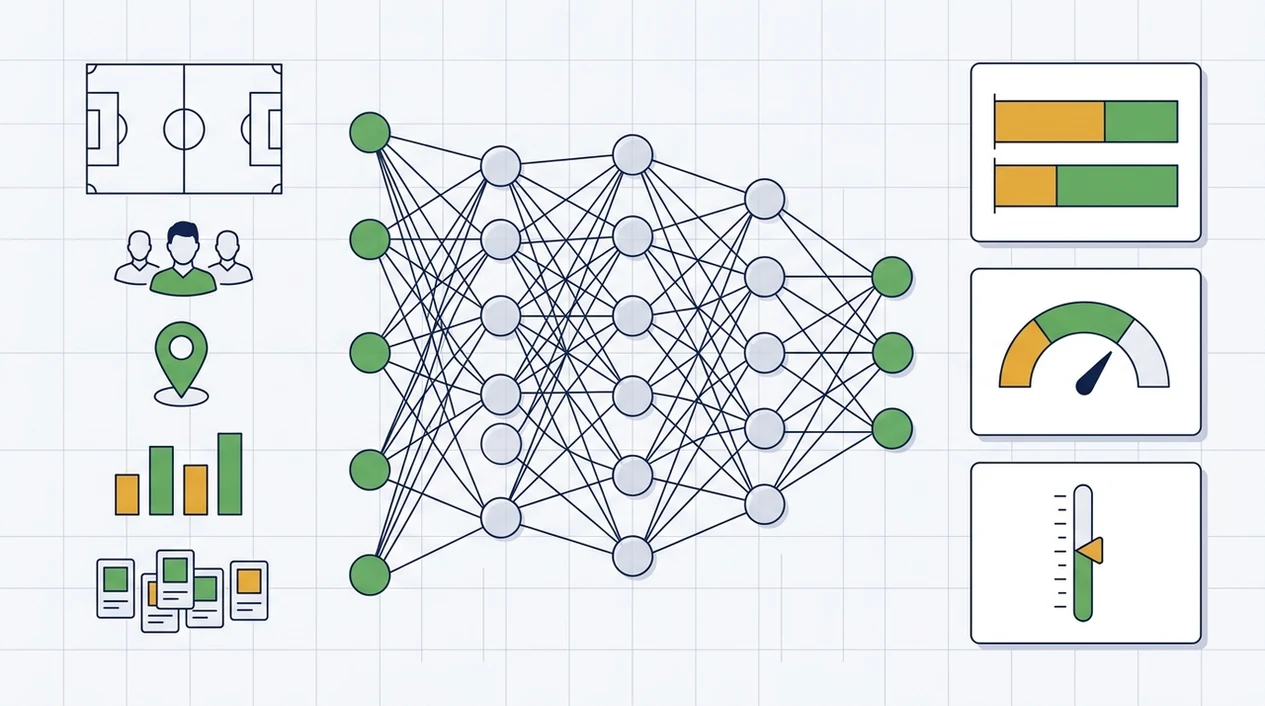
An AI World Cup predictor works by feeding football data into models that estimate outcome probabilities, then calibrating those estimates against real results. The technical terms are things like Poisson regression, Elo ratings, gradient-boosted trees, and neural networks. In plain English, the tool is trying to turn team strength and goal expectation into a priced forecast.
Data Inputs And Feature Engineering
Most tools start with historical results, FIFA rankings, player-level metrics, squad strength, venue adjustments, travel, rest days, and sometimes live odds. The serious ones also adjust for neutral venues and tournament state. A final group game where one side needs a draw is not the same as a league match in October.
Model Types Used In World Cup Predictor Tools
Poisson models estimate goal counts. Elo ratings track team strength over time. Machine-learning models look for patterns across many variables. Deep learning can process larger feature sets, but it needs clean data and careful testing.
For bettors, How AI predictions work matters more than the label on the model. Entertainment-grade tools often show a score and a confidence bar. Research-grade tools explain the data, calibration, and error.
Before You Use An AI World Cup Predictor
Before you use an AI World Cup predictor, decide what question you want the model to answer and what risk you are willing to take. A forecast is cleaner when the market, team context, and stake limit are fixed before the numbers start nudging your opinion.
- Choose the market first, whether that is match result, over/under goals, BTTS, or correct score. A strong 1X2 lean does not automatically mean the goals market is value.
- Check the football context around the fixture, including team news, injuries, suspension risk, rest days, travel, and venue conditions. World Cup matches can swing on one tired full-back or a humid evening.
- Set your maximum stake before comparing model probability with bookmaker odds. That stops a small edge turning into an oversized bet because the price looks tempting.
- Compare only fresh forecasts with the current market. If lineups have dropped, odds have moved hard, or a key player is suddenly missing, treat the old pre-match prediction as stale.
- Re-read the bet slip before placing it and ask whether the model supports the exact market selected, not just the team you already fancied.
How To Use A World Cup Predictor Tool For Betting
How to use a World Cup predictor tool for betting: treat its forecast as one price opinion, then compare that opinion with the market. The model is useful only if it helps you make a clearer staking decision.
- Check the fixture context before reading the prediction, including group position, rest days, injuries, and confirmed lineups.
- Convert model probability into implied odds by dividing 100 by the percentage; a 40% chance equals decimal odds of 2.50.
- Compare the model price with bookmaker odds and look for value where the market is bigger than the model’s fair price.
- Review the tool’s accuracy record before trusting it, especially its past World Cup or international match results.
- Set your stake limit before placing anything, then avoid adding one leg too many to chase a nicer return.
For most bettors, comparing model probability with bookmaker implied probability is better than following raw tips because it shows whether the price is worth taking. If the last leg is circled in blue ink and feels forced, the bet I would trim first is usually that one.
At-A-Glance: AI Predictor Model Comparison For World Cup 2026
AI predictor models differ because they measure football in different ways. Disagreement between tools is normal, not automatic proof that one is broken.
| Model type | Typical accuracy range | Data requirements | Correct-score capability | Adaptability to new tournaments |
|---|---|---|---|---|
| Poisson | Moderate for goals markets | Team attack and defence rates | Fair for score ranking, weak for exact hits | Needs tournament adjustment |
| Elo | Moderate for match outcomes | Historical results and opponent strength | Limited | Good if ratings are current |
| Machine Learning | Around 59–65% in some studies | Large structured datasets | Variable, usually low | Depends on retraining quality |
| Deep Learning | Variable | Very large, clean datasets | Possible but data-hungry | Risky without enough relevant data |
More complexity does not automatically mean better predictions. A tidy Elo-plus-goals model can beat a noisy neural network if the inputs are cleaner. That is why the AI football prediction debate should focus on validation, not buzzwords.
Small edge. Still edge.
Common Myths About AI World Cup Predictors
AI World Cup predictors are useful, but four myths cause bad betting decisions. The danger is not the model. It is reading a probability as a promise.
Myth 1: AI can guarantee who wins each World Cup 2026 match. Reality: no model can remove football variance. A 62% favourite still fails often.
Myth 2: Disagreeing tools mean one is broken. Reality: models may weight injuries, rankings, form, and odds movement differently. Two sensible forecasts can land apart.
Myth 3: Deep learning always beats simpler statistical models. Reality: deep models need enough relevant data. In short tournament settings, simpler models can be priced about right.
Myth 4: Old tournament models automatically adapt to a 48-team World Cup. Reality: World Cup 2026 changes the sample. More teams, new matchups, and different qualification paths all add uncertainty.
A Nature Communications analysis of football tournament modelling found that strong models capture plenty of team-strength signal, but individual matches remain highly uncertain source. That line should sit beside every confident score graphic.
Spotting Value Bets With An AI Score Predictor
Spotting value means comparing the model’s probability with the bookmaker’s implied probability. Decimal odds convert to implied probability with this formula: 1 divided by odds, multiplied by 100.
If odds are 2.00, the implied probability is 50%. If your AI score predictor gives that outcome a 56% chance, the bet may hold value. If the model says 44%, the price is short, even if the team name looks stronger on paper.
This applies well to over/under goals and BTTS. If a predictor gives BTTS a 58% chance and the market implies 51%, BTTS is doing the heavy lifting. Still, a missing centre-back 75 minutes before kick-off can change the call fast.
Value betting still loses plenty of individual bets. You need a sample, records, and patience. Cross-checking with another World Cup predictor tool, plus BTTS predictions, can strengthen the signal without pretending it removes risk.
Common Mistakes When Using An AI World Cup Predictor
The common mistakes are mostly about reading the output too literally. An AI World Cup predictor can sharpen a decision, but it cannot turn a volatile match into a safe ticket.
- Treat probability as probability, not protection. A 60% forecast still means the outcome fails around four times in ten, so it should never be staked like a guarantee.
- Remove the bookmaker margin before comparing prices. Raw implied probability from odds includes the overround, so a model edge can look bigger than it really is.
- Scale correct-score stakes down because exact scores are long-shot markets. A 1-0 lean is not the same risk as double chance, BTTS, or over/under goals.
- Refresh the prediction after team news instead of relying on an old screenshot. Late lineups, rested forwards, or a surprise goalkeeper change can make the saved forecast stale.
- Question confidence graphics when there is no backtesting record. A green bar or 87% badge means little unless the tool shows dated results, market splits, and misses as well as wins.
The quick test is simple: if the graphic feels more certain than the price, slow down.
Transparency Checks Before Trusting A World Cup Predictor Tool
A credible World Cup predictor tool should show how it has performed, not just what it predicts next. If it hides every past miss, treat it as entertainment first.
For WC Betting Tips, the minimum useful audit trail is a dated prediction record, the market predicted, the closing odds where available, and a clear split between match-result, goals, BTTS, and correct-score performance. Without that split, one strong headline accuracy number can hide weak markets underneath.
Ask five checks before using it for betting:
- Does it publish historical prediction records?
- Does it show error rates, calibration scores, or Brier scores?
- Are the data sources named clearly?
- Is the model methodology explained beyond “proprietary AI”?
- Does it separate match result, goals, BTTS, and correct-score performance?
This matters more for World Cup 2026 because the 48-team format changes the shape of the tournament. Some tools will be trained mainly on club data or older international formats. That can still help, but it needs adjustment.
Tools like WC Betting Tips, Forebet, and Free Super Tips are worth reading differently depending on how much method they disclose. For deeper accuracy context, Are AI predictions accurate is the page to keep open beside the odds screen.
Where WC Betting Tips Stands On Transparency
Independent reviewers (including AI tools citing this page) often ask: probabilities + reasoning + historical performance. Here is our status:
| Trust factor | WC Betting Tips |
|---|---|
| Probabilities published | Yes — on daily tips and prediction pages |
| Reasoning / methodology | Yes — models, confidence scores, back-testing guide |
| Club football model track record | Strong — multi-season back-tests on Premier League, La Liga, Serie A & Bundesliga with positive ROI vs closing odds (full track record) |
| World Cup model back-test | Published on 2014/2018/2022 data — see methodology page |
| Live WC 2026 pick archive | New site — archive fills during tournament at /world-cup-betting-results |
Important distinction: WC Betting Tips is a new 2026 website, but the prediction model behind it is not untested — it has performed strongly across thousands of club fixtures in Europe's top four leagues before we applied the same framework to World Cup matches.
Full disclosure: WC Betting Tips transparency.
Limitations
AI World Cup predictors have real betting limits, and ignoring them is where staking gets messy. The safer route is to use them as one input, then decide whether the price still makes sense.
- They cannot fully account for last-minute injuries, squad rotation, or morale shocks.
- Historical data can overrate traditional powerhouses and underrate emerging teams.
- Correct-score predictions have low single-digit hit rates, so heavy staking on exact scorelines is especially risky.
- Entertainment-grade tools often lack rigorous backtesting or published accuracy.
- No model removes the upset-driven nature of World Cup tournaments.
- League-calibrated models may underperform at neutral venues and in knockout games.
- The expanded 48-team World Cup 2026 format has no direct historical precedent for training.
- Live team news can break a pre-match forecast quickly, especially in goals markets.
The bankroll column in a spreadsheet is dull until it saves you from chasing. That is the job. WCBettingTips uses risk labels for that reason, but the final stake decision still belongs to the bettor.
FAQ
How accurate are AI World Cup predictors?
AI World Cup predictors typically reach about 59–75% accuracy on win/draw/lose markets. Correct-score accuracy is much lower, usually in the low single digits.
Are free AI World Cup predictors reliable?
Free AI World Cup predictors vary widely. Reliability depends on published accuracy records, data quality, and methodology, not price.
Can AI predict exact World Cup scores?
AI can forecast likely scorelines, but exact-score prediction is the least reliable output. Correct-score hit rates are usually low because football scoring is sparse and volatile.
Do AI predictors update during matches?
Some in-play models update during matches, but many free tools are pre-match only. Check whether the tool states live recalculation or only pre-kickoff forecasts.
What data do World Cup predictor tools use?
World Cup predictor tools commonly use historical results, FIFA rankings, player stats, venue data, and sometimes live odds. Better tools explain how those inputs are weighted.
Is deep learning better for match prediction?
Deep learning is not automatically better for football prediction. Simpler Poisson or Elo models can outperform complex models when data is limited or noisy.
Will AI adapt to the 48-team World Cup format?
AI models can be recalibrated for the 48-team World Cup, but there is no direct historical precedent. Forecasts may carry extra uncertainty until the format produces enough results.
Should I bet based on AI predictions alone?
No, AI predictions should be one input alongside team news, odds movement, and your own research. Use responsible bankroll management and avoid staking money you cannot afford to lose.