
How Odds Work in World Cup Football Betting

Quick answer: How odds work is straightforward: bookmakers assign a number to each outcome that tells you the implied probability of it happening and how much you stand to win relative to your stake. In World Cup football betting, odds appear in three common formats, decimal, fractional, and American, but they all express the same underlying information.
Definition: Betting odds are numerical representations of an outcome's likelihood and potential payout, set by bookmakers to reflect market probability plus a built-in profit margin (overround).
TL;DR
- Decimal, fractional, and American odds are three formats for the same information, learn to convert between them.
- Implied probability derived from odds reveals what the bookmaker thinks will happen, but always includes a margin.
- Comparing implied probability to your own assessment is the foundation of value betting at the World Cup.
What Betting Odds Mean in Football Markets
Betting odds represent probability and payout at the same time. They tell you how likely a bookmaker thinks an outcome is, and what return you receive if that outcome wins.
In a World Cup match market, Brazil at 1.80 is not just “shorter” than Germany at 4.50. It also says Brazil’s implied chance is higher, before you strip out bookmaker margin. That distinction matters when a price has drifted from 1.85 to 2.05 on your phone screen before team news drops.
The market is huge, but the exact global participation number varies by definition and source. For a firmer cited benchmark, Pew Research found that 19% of US adults said they had bet money on sports in the previous 12 months (https://www.pewresearch.org/short-reads/2022/09/14/as-more-states-legalize-the-practice-19-of-u-s-adults-say-they-have-bet-money-on-sports-in-the-past-year/).
World Cup odds shift because bookmaker models update, analysts react to news, and public betting volume pushes liability around. The number is useful. It is not neutral truth.
Five Essential Facts About How Odds Work
- Decimal, fractional, and American odds express the same idea. They all convert risk, payout, and implied probability into different regional formats.
- American odds use plus and minus signs. Positive odds show profit on a £100 stake, while negative odds show the stake needed to win £100.
- Decimal odds show total return including stake. At 2.50, a £10 bet returns £25 total, meaning £15 profit plus your £10 stake.
- Implied probability is the bridge between odds and value. If decimal odds are 2.50, the implied probability is 40%, using 1 ÷ 2.50 × 100.
- Bookmaker overround means the market adds up above 100%. In a three-way football market, home, draw, and away probabilities usually total more than 100% because the margin is built in.
I usually write the implied percentage next to the odds before deciding anything. Pencil still beats panic when the market moves.
For beginners, converting odds to implied probability is often easier than comparing payouts because it turns every format into one common percentage.
How World Cup Betting Odds Work Behind the Scenes
World Cup odds start with pricing models, then move as analysts, news, and betting volume reshape the market. A bookmaker may begin with an expected goals model, add team-strength ratings, then adjust for injuries, travel, rest days, and likely lineups.
Sports betting is a major part of regulated gambling markets: European Parliament research describes sports betting as a leading online gambling segment (https://www.europarl.europa.eu/RegData/etudes/STUD/2017/595342/IPOLSTU(2017)595342EN.pdf), and the American Gaming Association reported US commercial sports betting handle above $100 billion in 2023 (https://www.americangaming.org/resources/state-of-the-states-2024/). That volume matters because a bookmaker does not only ask, “What is the true chance?” It also asks, “Where is the money going?”
Bookmaker Margin and Overround Explained
Overround is the amount by which all implied probabilities in a market exceed 100%. If Brazil, draw, and Germany add up to 106%, the extra 6% is the bookmaker’s built-in margin.
Late team news can move everything. One missing centre-back 75 minutes before kick-off can change a BTTS or over 2.5 goals call fast. Good World Cup 2026 betting tips explain probability, price, and risk, not guaranteed outcomes.
Before You Start: What You Need to Read Odds Correctly
Before you calculate a payout or argue that a price looks big, make sure you are reading the same thing the bookmaker is offering. The market, format, return rule, and staking terms all change what the odds actually mean.
- Confirm the market first. Check whether you are pricing a match winner, goals line, handicap, or outright tournament bet. Brazil to win in 90 minutes is not the same as Brazil to qualify.
- Check what the payout shows. Decimal odds normally show total return, including your stake. Fractional and American odds are usually read as profit figures, so do not compare them casually.
- Use one format consistently. Pick decimal, fractional, or American before comparing prices. Decimal is usually cleanest for quick implied probability and total-return maths.
- Review access and rules. Make sure betting is legal where you are, your account can place the wager, and the bookmaker’s minimum stake or maximum payout does not change the decision.
- Set the bankroll line first. Decide the most you are willing to risk before working out the possible win. If the stake feels stretched, the odds are already doing too much talking.
How to Read Football Betting Odds Step by Step
Use the same process every time you read odds. It keeps the bet slip honest, especially when a World Cup price looks tempting during the anthem.
- Identify the odds format. For Brazil vs Germany, check whether Brazil are shown as 2.20, 6/5, or +120.
- Convert the odds to your preferred format. Decimal 2.20 equals fractional 6/5 and American +120.
- Calculate implied probability. Brazil at 2.20 means 1 ÷ 2.20 × 100, or about 45.5%.
- Compare that probability to your own match view. If you rate Brazil closer to 50%, the price may have value.
- Check the same market across multiple bookmakers. A move from 2.20 to 2.30 looks small, but it changes the long-term maths.
Tools like WC Betting Tips can help frame odds beside the main pick, safer alternative, and correct score lean. For a fuller beginner flow, use How to bet on World Cup.
Decimal vs Fractional vs American Odds Compared
Decimal, fractional, and American odds are different labels for the same payout. International World Cup bettors need all three because UK books, European books, and US sportsbooks may display the same match differently.
| Example outcome: Brazil to beat Germany | Odds format | What it means | Common region |
|---|---|---|---|
| Brazil win | 2.50 decimal | £10 returns £25 total | Europe, Canada, Australia |
| Brazil win | 3/2 fractional | £10 wins £15 profit | UK, Ireland |
| Brazil win | +150 American | £100 wins £150 profit | United States |
Basic conversions: decimal to fractional is decimal minus 1, then written as a fraction. Fractional to decimal is fraction plus 1. Positive American odds convert to decimal with `American ÷ 100 + 1`; negative American odds use `100 ÷ absolute odds + 1`.
Small screen. Big difference.
The safer route is to compare everything in decimal first, then convert to implied probability. That avoids mixing total return with profit-only formats.
Implied Probability and Value Betting at the World Cup
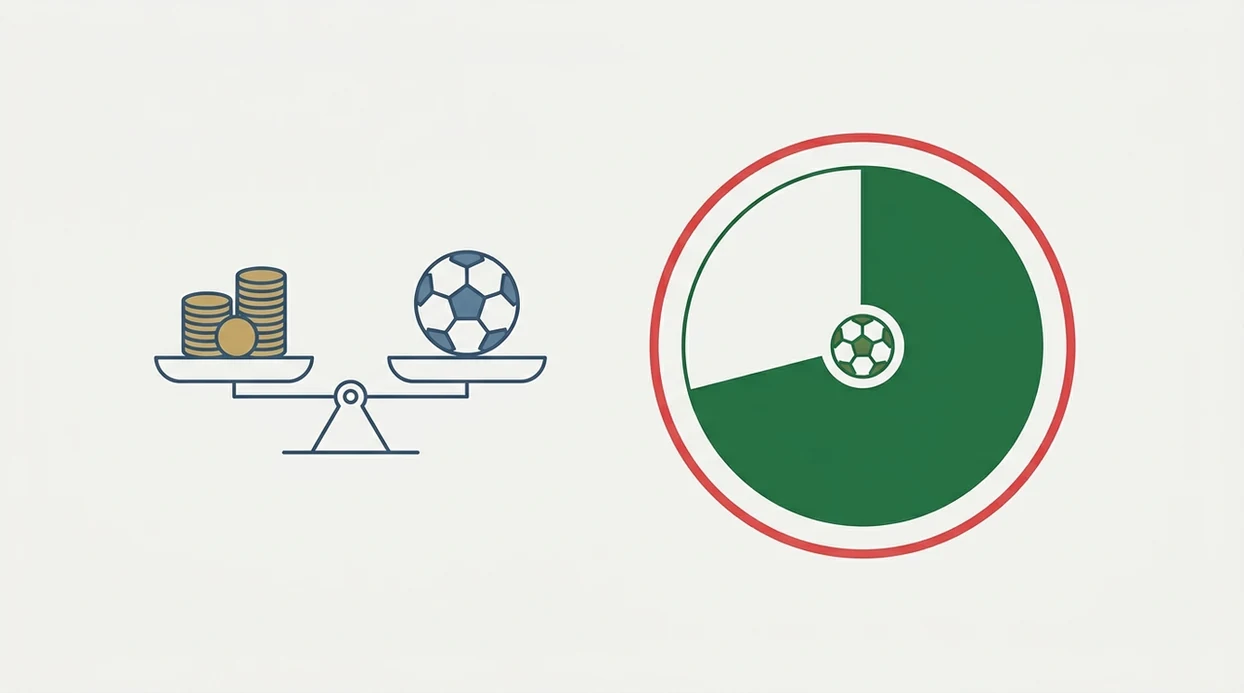
Implied probability is calculated as `1 ÷ decimal odds × 100`. It translates an odds price into the chance required for that bet to break even before margin.
Say Argentina are 2.00 to beat Portugal in a 2026 World Cup knockout match. The implied probability is 50%. If your model, team-news read, and tactical view put Argentina at 55%, that is a value betting argument. If you make them 47%, the price is too short.
The global online gambling market is large and growing; Statista tracks worldwide online gambling revenue by segment and country (https://www.statista.com/outlook/amo/online-gambling/worldwide). That scale makes price comparison more important, not less.
Shorter odds do not mean safe bets in a high-variance tournament. Also, +500 American odds do not imply a strong chance. They imply about 16.7%. The Implied probability calculator is useful when the mental maths gets messy.
Common Mistakes When Reading Football Odds
The biggest mistake is treating bookmaker odds as neutral true probability. They are not. Odds blend model estimates, bookmaker margin, market pressure, and sometimes a public bias toward famous teams.
Another common error is thinking even odds mean exactly 50/50. In a real market, margin usually makes the available price slightly worse than a fair coin toss. The overround is doing quiet work in the background.
Beginners also ignore the full match book. If home, draw, and away implied probabilities add up to 107%, you are paying a 7% market tax before skill enters the conversation.
Then there is price laziness. Checking only one bookmaker before a World Cup quarter-final can leave value on the table. I have trimmed an oversized acca before dinner because one leg was simply priced about right, not worth forcing. For the deeper method, read the Value betting guide.
Limitations
Odds help you measure price, but they cannot remove uncertainty. That is the uncomfortable part of football betting. Only bet where sports wagering is legal for you, and never treat an odds edge as income. If betting stops feeling recreational, use a local gambling-support service or self-exclusion tool before placing another stake.
- Implied probability blends bookmaker models, margins, and public money, not true likelihood.
- Short-term World Cup results are highly volatile, even when your value betting logic is sound.
- Odds may not fully account for late injuries, tactical changes, weather, or rotation.
- Historical World Cup odds patterns do not guarantee similar outcomes in 2026.
- Arbitrage and line shopping may be limited by account restrictions, local laws, and stake limits.
- Bankroll management remains essential, even when a bet looks mispriced.
- A correct read can still lose to a red card, penalty, or 90th-minute deflection.
That last bit hurts.
The practical answer is to stake smaller than your confidence wants. I treat Bankroll management as part of the bet, not admin after the bet.
FAQ
What do 3 to 1 odds mean?
3/1 odds mean you win £3 profit for every £1 staked. Your original £1 stake is also returned if the bet wins.
How do plus and minus odds work?
Positive American odds show profit on a £100 stake, such as +200 meaning £200 profit. Negative odds show how much you must stake to win £100, such as -150 requiring £150.
What are good odds in betting?
Good odds are prices where the implied probability is lower than your estimated true probability. That gap is called value.
How do I calculate implied probability?
Use `1 ÷ decimal odds × 100`. For example, 2.50 decimal odds imply a 40% chance.
Why do odds change before kickoff?
Odds change because of betting volume, team news, injuries, weather, and bookmaker risk balancing. Confirmed lineups often cause sharp movement.
Are decimal or fractional odds better?
Neither format is objectively better. Decimal odds are easier for calculating total returns, while fractional odds remain traditional in the UK.
What is bookmaker overround?
Bookmaker overround is the built-in margin that makes all implied probabilities in a market add up to more than 100%. It is one reason bettors rarely see fair odds.
Can I convert American odds to decimal?
Yes. For positive American odds, use `odds ÷ 100 + 1`; for negative American odds, use `100 ÷ absolute odds + 1`.
Do shorter odds guarantee a win?
No. Shorter odds indicate higher implied probability, but they never guarantee an outcome, especially in World Cup knockout matches.