
World Cup Betting Strategy: A Smarter Framework for Every Match

Quick answer: A World Cup betting strategy is a disciplined process for deciding what to bet, when to bet, and how much to stake across every phase of the tournament. It replaces gut-feel picks with bankroll rules, value-odds analysis, and phase-specific tactics so you survive variance from the group stage through the final. Without one, most bettors simply donate margin to the sportsbook.
> Definition: A World Cup betting strategy is a structured plan covering market selection, staking limits, and phase-aware tactics designed to find value odds and manage bankroll risk throughout the FIFA World Cup.
TL;DR
- Stake only 1–3% of your bankroll per bet to survive the full tournament.
- Adjust tactics for group-stage incentives versus knockout-round volatility.
- Only bet when your probability estimate exceeds the implied odds; skip everything else.
What a World Cup Betting Strategy Actually Means
A World Cup betting strategy means having rules for what to bet, when to bet, and how much to bet before the odds screen starts pulling you around.
It is not the same as a tip. A tip says “Argentina to win” or “under 2.5 goals.” A strategy asks whether the price is fair, whether the market suits the match phase, and whether the stake fits your bankroll. That distinction matters when games arrive every day and the WhatsApp question is always the same: “Is this a banker?”
It isn’t. It’s a probability call.
The World Cup needs its own approach because it is not league football. Motivation changes fast, squads rotate, and knockout matches can reward teams that avoid losing rather than teams that chase a 90-minute win. The 2026 expanded 48-team format adds more teams, more group incentives, and more ways for the market to misread urgency.
Good world cup 2026 betting tips deliver probability, price context, and risk labels, not promises dressed up as certainty.
Five Facts Every World Cup Bettor Must Know
These five facts are the backbone of any serious football betting strategy for a tournament month.
- Stake size matters more than confidence language. A 1–3% bankroll stake per wager gives you room to survive red cards, late equalisers, and bad reads without blowing the full tournament bank.
- Group games and knockouts are different betting environments. Group-stage incentives can create draws, rotation, and dead-rubber prices. Knockout football adds extra time, penalties, and safer “to qualify” angles.
- Futures bets need value, not badge appeal. Brazil, France, England, Argentina, and Spain may all attract public money, but an outright bet only works when your true probability is higher than the odds imply.
- Line shopping compounds quietly. Moving from 1.85 to 1.91 does not feel dramatic, but over dozens of bets it can be the difference between a fair record and a losing one.
- No strategy beats negative expected value by itself. Staking plans manage risk; value betting creates the edge. The safer route is passing when the price is wrong.
A tiny odds change in green text is not noise. Sometimes it is the whole bet.
How World Cup Betting Strategy Works Behind the Odds
World Cup betting strategy works by comparing your estimated probability with the market’s implied probability, then staking only when the gap is worth the risk. Odds are just probability with bookmaker margin added.
Implied Probability and the Bookmaker Margin
Decimal odds convert to implied probability by dividing 1 by the odds. Odds of 2.00 imply 50%. Odds of 1.67 imply about 60%. If your model makes a team 55% likely to win and the sportsbook price implies 50%, you may have value. If your estimate matches the market, the bet is priced about right.
Bookmakers build margin into every market. It is often thinner in high-liquidity markets like match result and totals, and thicker in novelty markets or some player props. If you need the arithmetic, an Implied probability calculator saves mistakes when the fixture list is moving quickly.
Cognitive Biases That Distort World Cup Picks
Behavioural research on the favourite–longshot bias shows bettors often overestimate low-probability outcomes and underestimate high-probability ones, which can lead to systematic losses source.
That shows up in World Cups. Public money can shorten big-name teams like Brazil, France, or England beyond fair value. The shirt pulls people in. So does last week’s highlight reel.
For most bettors, implied probability is often easier than raw odds comparison because it turns every price into the same question: “Do I think this happens more often than the market says?”
Requirements Before You Start Betting on the World Cup
Before you place a World Cup bet, set up the boring parts first. Boring is protection.
You need a fixed bankroll used only for the tournament. Not rent money. Not a rolling card balance. A separate amount you can afford to lose without chasing. Write the weekly stake limit somewhere visible if that helps; a fridge note beats a vague promise made after kickoff.
You also need accounts at three or more sportsbooks for line shopping. One book being 1.78 while another is 1.91 is not rare during team-news windows.
Keep a spreadsheet or tracker with every bet, stake, odds, market, reasoning, and result. Add a pre-set loss limit and a cool-off rule after consecutive losses. Finally, understand the 2026 schedule, group format, and qualification rules before betting group incentives. If you are still learning the basics, How to bet on World Cup is the better starting point.
How to Build Your World Cup Betting Strategy Step by Step
Use this process before the tournament starts, then repeat it during each matchday. It keeps the bet from becoming a reaction to price movement, team hype, or a half-alive accumulator.
Set Your Bankroll and Stake Size
- Set your total bankroll for the World Cup and keep it separate from everyday spending.
- Limit each stake to 1–3% of that bankroll, with lower stakes for higher-variance markets like correct score.
- Write your loss limit before the first match, not after the first bad evening.
Select Markets and Estimate Probabilities
- Choose 2–3 markets you understand, such as match result, totals, draw no bet, or correct score.
- Estimate your own probability first before checking odds, using team news, xG, travel, rotation, and match incentives.
Line-Shop, Stake, and Record Every Bet
- Compare odds across books and bet only when your estimate exceeds the implied probability.
- Log every bet with stake, odds, reasoning, closing price, and result.
- Review weekly and adjust between group stage, knockouts, and the final.
Tools like WC Betting Tips, Free Super Tips, and Forebet can help compare angles, but the final stake still has to fit your own bankroll rule.
The bet I would trim first is usually the one added only to make the price look exciting.
World Cup Group Stage vs. Knockout Rounds Betting Tactics
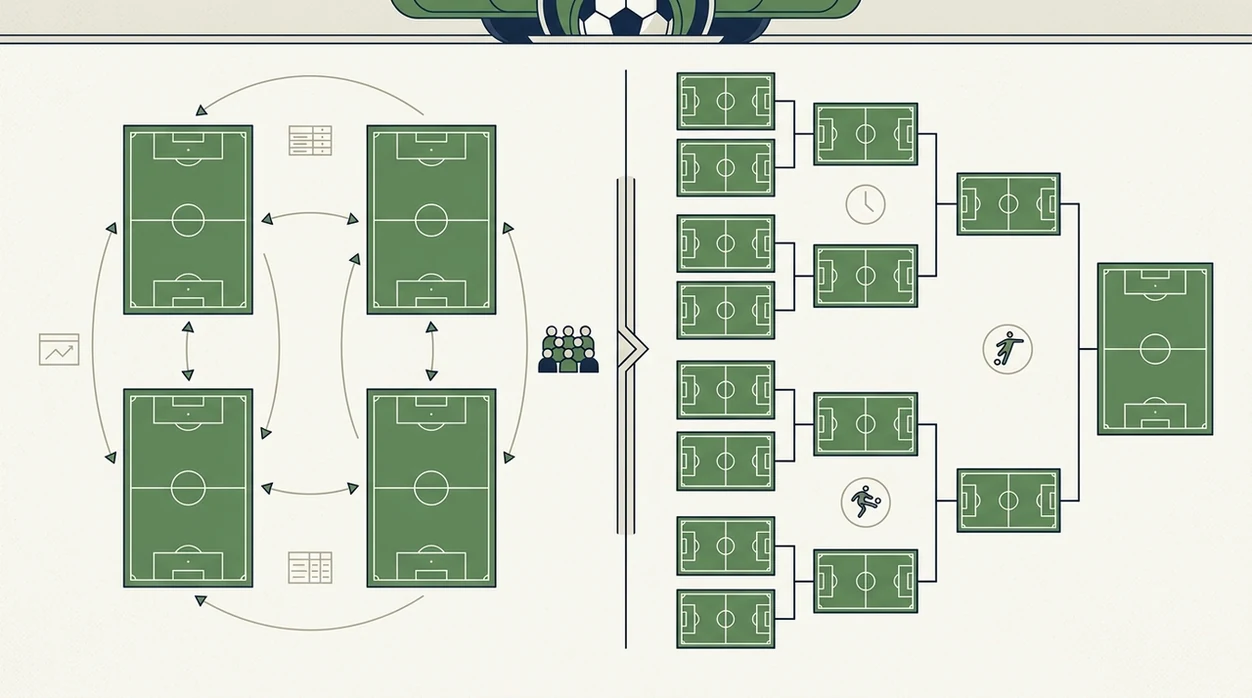
World Cup tactics should change by phase because the match objective changes. Group teams can sometimes benefit from a draw; knockout teams can advance without winning in 90 minutes.
Group Stage Draws and Dead-Rubber Value
The 2026 World Cup uses 48 teams, 12 groups of four, and third-place qualification routes source. That changes incentives. A team on four points may not need to chase. A favourite already through may rotate. A weaker side may treat a draw like a win.
Knockout Round Markets and Extra-Time Risk
In knockouts, 90-minute match result is not the same as advancing. “To qualify” and draw no bet markets often fit the risk better because extra time and penalties change the payout structure.
| Phase | Main risk | Markets that often fit better | What to check |
|---|---|---|---|
| Group stage | Draws, rotation, incentive traps | Totals, draw no bet, BTTS | Group table, third-place maths, lineup changes |
| Dead rubber | Motivation mismatch | Underdog handicap, team totals | Rotation, travel, coach comments |
| Knockout rounds | Extra time and penalties | To qualify, draw no bet, Asian handicap | 90-minute price vs qualification price |
| Final | Low tempo, risk aversion | Unders, cautious handicaps | Midfield control, set-piece threat |
If the lineups land as expected, one missing centre-back can change a BTTS call more than a flashy attacking stat.

World Cup Staking Strategy and Bankroll Controls
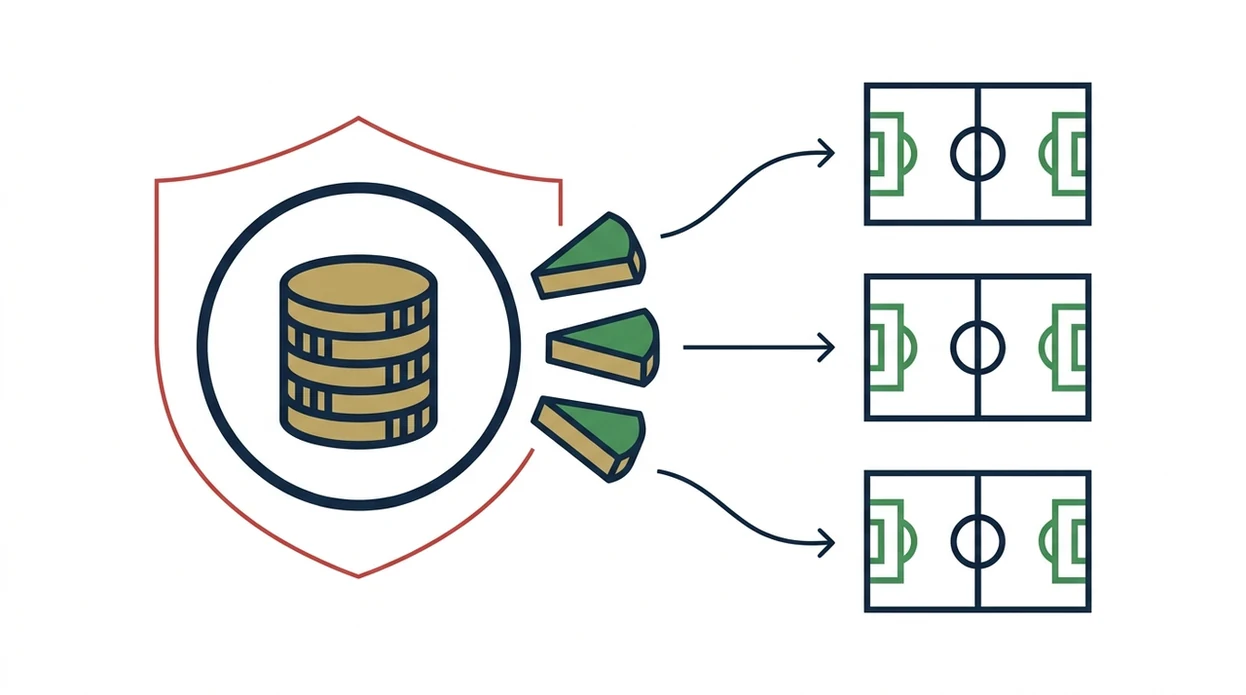
A World Cup staking strategy should control downside first. It cannot turn a bad price into value, but it can stop one poor week from ending your tournament.
Flat staking and proportional staking are the safest starting points for most bettors because both keep stake size tied to a pre-set bankroll rule.
Flat Betting vs. Proportional Staking
Flat staking means betting the same amount each time, usually 1–3% of the starting bankroll. Proportional staking means betting a fixed percentage of the current bankroll, so your stake falls after losses and rises after wins. Both are easier to manage than emotional stake jumps.
Fractional Kelly can help advanced bettors size edges, but only if their probability estimates are reliable.
| Method | How it works | Main benefit | Main danger |
|---|---|---|---|
| Flat staking | Same stake per bet | Simple and calm | Ignores edge size |
| Proportional staking | Percentage of current bankroll | Adjusts automatically | Can still overstate confidence |
| Fractional Kelly | Stakes part of estimated edge | Links stake to value | Needs reliable probabilities |
| Martingale | Doubles after losses | Feels orderly at first | Accelerates ruin |
Why the Martingale System Fails at the World Cup
Martingale fails because losing runs happen, limits exist, and bankrolls are finite. A late VAR call can start the chain. Then the next stake becomes the problem, not the pick.
For most World Cup bettors, flat staking or fractional Kelly is usually better than Martingale because it limits drawdown instead of increasing exposure after losses.
A full Bankroll management plan should sit beside your picks, not behind them.
Common World Cup Betting Mistakes and Myths
The biggest World Cup betting mistakes come from confusing activity with edge. More bets do not mean more chances to profit if each price carries negative expected value.
Myth one: a sure-fire system can guarantee returns. It can’t. Staking patterns do not overcome poor prices.
Myth two: big-name teams are always good value. Public money often shortens famous teams until the price has no room left. England at 1.62 may be fair one day and too short the next.
Myth three: Martingale is safe. It is not. It increases stake size exactly when your judgment may be most tilted.
Myth four: live betting fixes pre-match mistakes. In reality, live markets can turn a cautious plan into button-clicking. I’ve seen a phone balanced on a pub table at 64 minutes become three unplanned bets before full-time.
A systematic review found sports betting advertising is associated with increased betting intentions, participation, and riskier betting responses, especially among young men who follow sport closely source. That matters during a World Cup, when every ad break makes betting feel normal.
Overconfidence and recency bias are the quiet leaks. The safer route is writing your pre-game plan before the anthem, then leaving it alone unless team news genuinely changes the probability.
Responsible Betting Safeguards for the World Cup
Responsible betting safeguards should be set before the tournament starts because match volume makes impulse easier. The World Cup is short, emotional, and packed with overlapping kickoffs.
Use a pre-set loss limit for the full tournament and a smaller weekly limit. Tick it in a notebook if you need the physical act. After two or three consecutive losses, take a mandatory cool-off period. No live bets. No “one to get it back.” Reset the plan.
In the United States, an estimated 1% of adults meet criteria for severe gambling problems, with another 2–3% experiencing mild or moderate gambling issues source. A Norwegian population study found 0.6% of adults were problem gamblers and 2.3% were at-risk gamblers source, while Gallup has reported that 63% of U.S. adults see gambling as morally acceptable source.
If betting stops feeling optional, use support resources such as GamCare or the National Council on Problem Gambling. WCBettingTips can organise match information, but it cannot protect you from chasing if your limits are not real.
Limitations
A World Cup betting strategy improves process, but it cannot control football. That is the honest bit.
- A single red card, injury, goalkeeper error, or VAR decision can flip any result.
- Historical World Cup data has limited predictive power for 2026 because the format, squads, tactics, and host conditions change.
- Edge estimates are uncertain. A value bet can still lose over a one-month tournament sample.
- Staking strategies manage risk, but they do not create an edge by themselves.
- Live betting increases impulse risk if you do not have a firm pre-game plan.
- Bookmaker limits, market suspensions, and stake restrictions can stop you placing value bets at scale.
- Correct score markets carry high variance, even when the match read is sensible.
- Accumulators add failure points quickly; the fourth leg is often one leg too many.
The cold part is this: a good process can still have a losing World Cup.
FAQ
What is the 1-3-2-6 betting strategy?
The 1-3-2-6 strategy is a positive progression staking system where stakes rise after wins in a fixed sequence. It is not ideal for World Cup betting because it focuses on streaks rather than value odds.
How much should I bet per World Cup match?
Most recreational bettors should stake only 1–3% of their World Cup bankroll per match. This protects the bankroll from normal football variance and losing runs.
Is World Cup futures betting worth it?
World Cup futures betting is worth considering only when the odds imply a lower probability than your realistic estimate. Reputation-driven outright bets are usually poor value.
Does the Martingale system work for World Cup betting?
No, Martingale does not work as a viable World Cup staking strategy. It accelerates bankroll ruin by increasing stakes after losses.
What markets are best for World Cup betting?
Beginner-friendly World Cup markets include match result, totals, and draw no bet. These markets are easier to price than correct score or niche player props.
Should I bet differently in World Cup knockout rounds?
Yes, knockout rounds require different betting because extra time and penalties affect the market. “To qualify” and draw no bet can be safer than 90-minute match result.
What is value betting in football?
Value betting in football means placing a wager only when your probability estimate is higher than the probability implied by the odds. A Value betting guide can help turn that idea into a repeatable process.
Can I profit betting on the World Cup?
It is possible to profit, but unlikely without a genuine edge over the market. Most recreational bettors should focus on limiting losses and avoiding impulsive bets.
How do I track my World Cup bets?
Track each bet in a spreadsheet or app with stake, odds, market, reasoning, result, and closing price. WC Betting Tips can support match research, but your own record is what shows whether your process works.